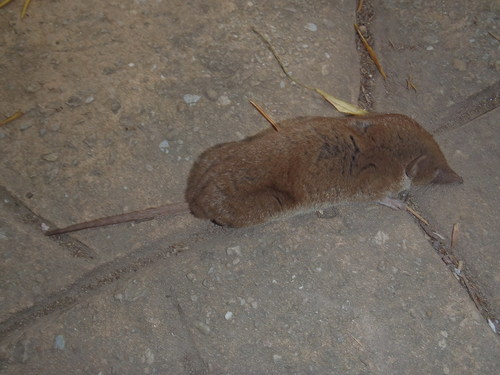
Reddish-gray Musk Shrew
Crocidura cyanea
The Reddish-gray Musk Shrew is a tiny, high-velocity hunter that thrives in the hidden corners of African gardens and grasslands. With a specialized snout and a relentless appetite, this 'garden helper' is a master of pest control.
Quick Identification
Size
Head-body length: 6-10 cm (2.4-4 in); Tail: 4-6 cm (1.6-2.4 in); Weight: 5-15 grams (0.2-0.5 oz)
Colors
Bicolor coat featuring a blend of reddish-brown and slate gray on the upperparts with a paler grayish-white underbelly
Key Features
- Long, flexible pointed snout with sensitive whiskers
- Dense, velvety reddish-gray fur
- Small, bead-like eyes and ears partially hidden by fur
- Strong musk glands located on the flanks
When You’ll See Them
Geographic range
Where Does the Reddish-gray Musk Shrew Live?
Native to the African continent, the Reddish-gray Musk Shrew occupies a vast range spanning from the southern tip of Africa up through East and Central Africa. It is a common resident in South Africa, Namibia, Botswana, and Zimbabwe, with populations extending north into the Democratic Republic of the Congo, Tanzania, and as far west as Nigeria. This adaptable mammal is found in almost any environment that provides sufficient ground cover and moisture for its insect prey.
Basemap © OpenStreetMap contributors
Behavior
The Reddish-gray Musk Shrew is a solitary and high-energy insectivore that spends the majority of its waking hours hunting. Driven by a metabolic rate so high that it must consume nearly its own body weight in food every 24 hours, this species moves with a characteristic frantic, darting motion. While they are primarily active at night to avoid predators, they may emerge during the day if food is scarce or if they are protected by dense leaf litter.
These shrews are highly territorial and use potent scent glands on their sides to mark their paths and discourage intruders. In a backyard setting, they are shy and rarely seen in the open, preferring to tunnel under mulch or follow the edges of walls and logs. Despite their small size, they are fierce predators of invertebrates and can be surprisingly vocal, emitting high-pitched chirps and squeaks when communicating or threatened.
EverydayEarth exclusive
Camera Tips
To capture the Reddish-gray Musk Shrew on camera, you must think small and stay low. These shrews rarely leave the safety of ground cover, so your camera should be positioned no higher than 10 centimeters (4 inches) off the ground. Aim the lens along 'natural runways'—the narrow gaps between garden rocks, the edge of a porch, or a clear path through the leaf mulch. Because they move so quickly, a camera with a fast trigger speed (0.2 seconds or less) is essential to avoid getting photos of just a disappearing tail.
Using a lure is the most effective way to get a clear, stationary shot. A small amount of wet cat food or a few mealworms placed inside a hollow log or under a propped-up piece of bark will encourage the shrew to stop and forage. If your camera has a 'macro' setting or a focus adjustment, use it; these animals are so small that they often appear blurry if the camera is focused on the background rather than the immediate foreground where the bait is placed.
Since these shrews are most active during the dark, ensure your camera uses 'No-Glow' or 'Black' infrared LEDs. Standard red-glow LEDs can sometimes startle sensitive small mammals, causing them to bolt. Set your camera to record short 5-10 second video clips rather than still images. Shrews are constantly moving their snouts and twitching their whiskers; a video captures these fascinating behaviors much better than a single frame ever could. Check your setup after a light rain, as the damp soil brings insects to the surface, making the shrews particularly active.
Frequently Asked Questions
Record Reddish-gray Musk Shrew at your habitat
Connect a camera to start building your own species record — AI identifies every visitor automatically.