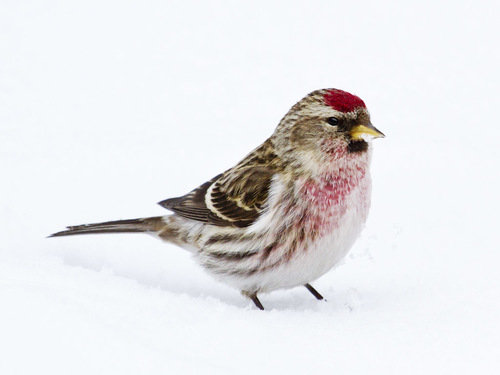
Redpoll
Acanthis flammea
A hardy survivor of the Arctic tundra, the Redpoll brings a splash of crimson and boundless energy to winter backyards. These acrobatic finches are famous for their social 'charms' and their ability to thrive in the coldest conditions on Earth.
Quick Identification
Size
Length: 11.5–14 cm (4.5–5.5 in); Wingspan: 20–22 cm (8–9 in); Weight: 10–16 g (0.35–0.56 oz)
Colors
Streaky brown and gray upperparts with a white belly. Both sexes feature a distinctive bright red patch on the forehead (the 'poll') and a small black patch around the chin. Adult males are distinguished by a rosy-pink wash across the breast.
Key Features
- Bright red patch on the forehead (the 'poll')
- Small black 'goatee' patch just below the yellow bill
- Deeply notched tail and heavily streaked brown-and-white flanks
- Tiny, pointed yellow beak with a dark tip
When You’ll See Them
Behavior
Redpolls are incredibly social and high-energy birds that travel in restless, chattering flocks known as 'charms.' They are famous for their irruptive winter migrations, where thousands of birds fly south from the Arctic in search of food when seed crops fail in the north. During these years, backyards can be swamped by dozens of these birds at once, creating a whirlwind of activity around feeders and nearby trees.
In the wild, they are remarkably hardy, surviving extreme cold by tunneling into the snow to stay warm at night. They are also highly acrobatic, often hanging upside down from thin birch or alder catkins to reach seeds. In backyard settings, they are relatively tame and may allow humans to get closer than many other finches, especially when they are focused on a high-energy meal during a cold snap.
EverydayEarth exclusive
Camera Tips
To capture the best Redpoll footage, position your camera at eye-level with a tube feeder filled with nyjer or fine sunflower chips. Because Redpolls are communal feeders, they often crowd a single feeder; using a camera with a wide-angle lens or placing the camera 2-3 feet back will allow you to capture the social dynamics of the entire flock rather than just one bird. If you are using an AI-powered camera, ensure the 'Motion Sensitivity' is set to high, as their movements are rapid and jittery.
During the winter months, when Redpolls are most likely to visit, lighting can be a challenge. Try to position your camera facing south to take advantage of the low winter sun, which will illuminate the crimson 'poll' on their heads and the pink wash on the males' breasts. If the ground is covered in snow, it acts as a natural reflector, filling in shadows and making your subjects pop against the white background. High shutter speeds are essential for these birds, as they rarely stay still for more than a second.
A unique trick for Redpolls is to provide a heated birdbath. In sub-zero temperatures, liquid water is a magnet for these birds, who need to drink and bathe to keep their feathers in top insulating condition. Placing a camera near the edge of a heated bath can capture stunning 'action shots' of splashing and preening that you won't get at a standard feeder. Set your camera to 'Burst Mode' or high-frame-rate video to catch the water droplets and the rapid fluttering of their wings.
Finally, don't forget the ground. Redpolls are messy eaters and will often spend as much time hopping on the snow beneath a feeder as they do on the perches. Placing a trail camera on a low tripod or a ground mount pointed at the 'drop zone' beneath your feeder can provide a different perspective and allow you to see the hierarchy of the flock as birds compete for fallen seeds. This is also where you are most likely to spot the rarer Hoary Redpoll hiding amongst the Common Redpolls.
Similar Species
Species that look similar or are commonly confused with Redpoll.
Frequently Asked Questions
Record Redpoll at your habitat
Connect a camera to start building your own species record — AI identifies every visitor automatically.