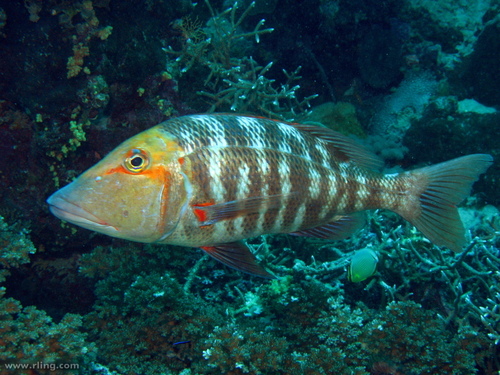
Redthroat Emperor
Lethrinus miniatus
A striking inhabitant of the Great Barrier Reef, the Redthroat Emperor is famous for its 'lipstick' red mouth and inquisitive personality. This prized reef fish is a master of the sandy seafloor, using its trumpet-like snout to hunt for hidden treasures.
Quick Identification
Size
Typically 40–60 cm (16–24 inches) in length, but can reach up to 90 cm (35 inches) and weigh up to 9 kg (20 lbs).
Colors
Silvery-grey to olive-brown body with prominent red or orange markings inside the mouth and at the base of the pectoral fins.
Key Features
- Elongated trumpet-like snout
- Bright red-orange coloration inside the mouth and around the throat
- Reddish base of the pectoral fins
- Large, expressive eyes set high on the head
When You’ll See Them
Geographic range
Where Does the Redthroat Emperor Live?
Native to the eastern Indo-West Pacific, the Redthroat Emperor is most famously associated with the Great Barrier Reef of Australia. Its core range extends through the Coral Sea, reaching the waters of New Caledonia and the Nansei Islands of Japan. While it is a staple of the tropical Australian coastline, it is also found in significant numbers around the island nations of the Southwest Pacific, where warm currents and healthy coral ecosystems support its population.
Basemap © OpenStreetMap contributors
Behavior
The Redthroat Emperor is an inquisitive and highly active marine predator that dominates the sandy margins of coral reefs. While juveniles are known to form large, bustling schools in shallow seagrass beds and lagoons, adults tend to become more solitary or move in smaller, loose-knit groups. They are known for their 'cleaner' relationships, often visiting stations where smaller fish remove parasites from their scales and gills.
These fish are extremely opportunistic and exhibit a high level of intelligence when foraging. They are often seen following larger rays or sharks, waiting to snatch up small prey items that are stirred up from the seafloor. In areas frequented by divers, they can become quite bold, though they maintain a cautious distance from unfamiliar disturbances. Their social structure is fascinating; they are protogynous hermaphrodites, meaning they begin life as females and can later transition into males as they grow larger and reach higher social status within their local population.
EverydayEarth exclusive
Camera Tips
Capturing the Redthroat Emperor requires specialized underwater equipment, as this species rarely ventures into water shallow enough for standard shore-based viewing. If you live on a coastline or visit a reef, an underwater 'drop camera' or a waterproof trail camera (like a GoPro with a high-capacity battery or a specialized housing) is your best bet. Secure your camera to a weighted base or a 'bommie' (a coral outcrop) at a depth of 5 to 15 metres. Positioning the camera near the edge of a reef where it meets a sandy floor is ideal, as this is where Redthroat Emperors love to hunt for crustaceans.
To guarantee a sighting, consider using a scent-based lure or a small bait cage (burley) filled with oily fish scraps or smashed sea urchins. Attach the bait cage about 1-2 metres in front of the lens. The Redthroat Emperor's curiosity and keen sense of smell will often lead them directly to the camera within minutes. Because water absorbs light, ensure your camera is positioned to take advantage of the midday sun (10 AM to 2 PM) for the best natural color, or use a wide-angle underwater video light to bring out the distinctive red 'throat' and pectoral fin markings.
Setting your camera to a high frame rate (60fps or higher) is recommended, as these fish move with sudden, jerky bursts of speed when they strike at prey. If you are using an AI-powered system, look for settings that can handle low-contrast environments, as the fish's silvery scales can sometimes blend with the shimmering light of the water column. In areas with high current, ensure your camera rig is heavy enough to remain stationary, as the movement of the camera itself can scare away more mature, cautious individuals.
Similar Species
Species that look similar or are commonly confused with Redthroat Emperor.
Frequently Asked Questions
Record Redthroat Emperor at your habitat
Connect a camera to start building your own species record — AI identifies every visitor automatically.