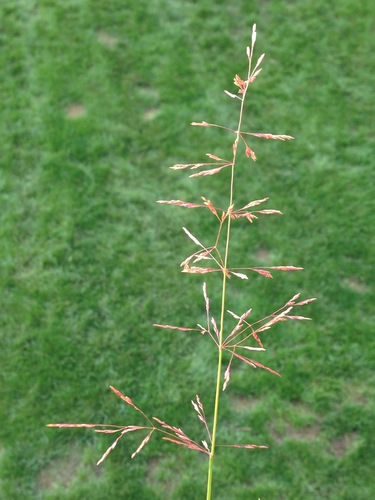
redtop
Agrostis gigantea
A hardy, rhizomatous grass that paints summer meadows with a shimmering wash of reddish-purple. Redtop is the unsung hero of the backyard, providing essential cover for wildlife and a stunning backdrop for nature photography.
Quick Identification
Size
Stems typically reach 40 to 120 cm (16 to 47 inches) in height with leaf blades 5 to 20 cm (2 to 8 inches) long.
Colors
Bright green foliage with distinctive reddish-purple to brownish-maroon flower panicles when in bloom.
Key Features
- Large, loose, spreading flower panicles
- Distinctive reddish-purple hue during summer bloom
- Stout underground rhizomes for spreading
- Flat, rough leaf blades with a prominent ligule
When You’ll See Them
Geographic range
Where Does the redtop Live?
Originally native to the temperate regions of Europe and Asia, Redtop has become a true global citizen. It is now widely naturalized across North America, where it thrives in almost every state in the U.S. and throughout southern Canada. You will also find established populations in parts of North Africa, Australia, and New Zealand, where it was historically introduced for agricultural purposes and erosion control.
Basemap © OpenStreetMap contributors
Behavior
Redtop is a hardy perennial grass that spreads through a combination of wind-dispersed seeds and vigorous underground rhizomes. Unlike many other bunchgrasses, its ability to form a sod makes it an excellent survivor in disturbed soils. It is often one of the first plants to colonize abandoned fields or roadsides, creating a shimmering red carpet effect during its peak flowering season in mid-summer.
In the backyard ecosystem, Redtop serves as a critical foundation species. It provides structural cover for ground-nesting birds and small mammals, while its flowering heads attract a variety of pollinators. While humans once heavily cultivated it for hay and pasture, it is now more commonly viewed as a naturalized part of the meadow landscape that requires very little maintenance once established.
EverydayEarth exclusive
Camera Tips
Capturing Redtop on camera requires a different approach than moving wildlife; think of it as the 'stage' for your backyard theater. To get the best shots of its namesake reddish hues, position your camera at a low angle, roughly 12 to 18 inches off the ground, facing toward the morning or evening sun. The backlighting will make the delicate purple panicles glow, creating a stunning visual contrast against the green stalks.
Because Redtop attracts various insects and small herbivores, it is a great spot to set up a 'micro-trail' camera. Aim your lens at a dense patch near the edge of a meadow. You are likely to capture Meadow Brown butterflies, various beetles, and even small rodents like voles using the grass as a 'green tunnel' for protection from predators. Use a high-speed trigger or a video mode, as the grass swaying in the wind can often trigger false positives on lower-quality sensors; adjust your sensitivity to medium to avoid filling your SD card with wind-blown grass.
For those interested in the 'slow life' of the garden, Redtop is a perfect subject for time-lapse photography. Set your camera to take one photo every hour during the late spring and early summer. When played back, you can watch the dramatic rise of the flower stalks and the eventual 'blushing' of the seeds as they turn from green to deep red. This is also a great way to monitor how different animals interact with the grass throughout the day, from morning dew-drinkers to nocturnal foragers seeking cover.
Frequently Asked Questions
Record redtop at your habitat
Connect a camera to start building your own species record — AI identifies every visitor automatically.