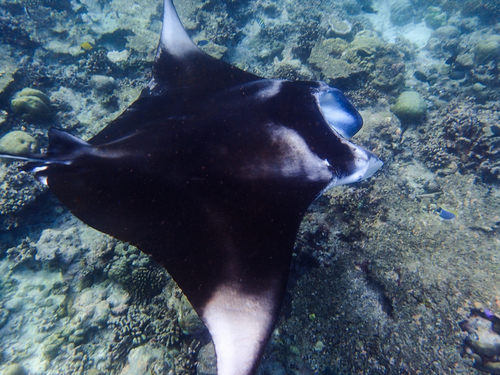
Reef Manta Ray
Mobula alfredi
Meet the Reef Manta Ray, the graceful giant of the shallow seas. Known for their incredible intelligence and unique 'fingerprint' spot patterns, these gentle filter-feeders are the crown jewels of the tropical reef.
Quick Identification
Size
Wingspan typically 3 to 3.5 meters (10–11.5 feet), reaching a maximum of 5.5 meters (18 feet); weight up to 700 kg (1,540 lbs).
Colors
Dorsal side is dark grey to black; ventral side is white with unique black spot patterns used for individual identification.
Key Features
- Large triangular pectoral fins
- Cephalic fins or 'horns' near the mouth
- Unique ventral spot patterns
- Terminal mouth located at the front of the head
- Lacks a stinging spine on the tail
When You’ll See Them
Behavior
Reef Manta Rays are among the most intelligent fish in the ocean, possessing the largest brain-to-body ratio of any cold-blooded fish. They are famous for their social 'cleaning' rituals, where they visit specific patches of reef to allow small cleaner wrasse to pick off parasites. This behavior is not just functional but highly social, often involving multiple rays queuing for their turn in a display of organized patience.
When it comes to feeding, they are true acrobats. They utilize several strategies including 'barrel rolling'—repeatedly flipping backward in the water to stay within a dense patch of plankton—and 'chain feeding,' where several rays swim in a line to create a vacuum effect. Unlike stingrays, they have no venomous barb and are completely harmless to humans, often showing a gentle curiosity toward swimmers and divers, sometimes even maintaining eye contact as they glide past.
EverydayEarth exclusive
Camera Tips
To capture a Reef Manta Ray on a remote camera, you need to think like a reef explorer. Since these are not your typical backyard visitors unless you live on a tropical coastline, the best approach is to use an action camera (like a GoPro or DJI Action) in a high-quality underwater housing. Mount your camera to a weighted plate or a low-profile tripod and place it near a known 'cleaning station'—usually a prominent coral head where you see smaller fish gathering. Set your camera to a wide-angle field of view to ensure the manta’s entire wingspan, which can reach over 11 feet, stays within the frame.
Lighting is the most critical variable underwater. If you are deploying the camera in shallow water (less than 10 meters), use the natural light available between 10 AM and 2 PM for the best color and clarity. Avoid using high-intensity LEDs pointed directly at the animal, as this can cause 'backscatter' from floating plankton, making the footage look grainy. Instead, position your camera so it faces slightly upward; this silhouettes the ray against the surface light and highlights the unique black spot patterns on its white belly, which are essential for identifying individual rays if you plan to contribute to citizen science databases.
For settings, use a high frame rate like 60fps or 120fps. Mantas move with a slow, rhythmic wing-beat that looks stunning in slow motion. If your camera has a 'looping' mode or an underwater motion trigger, utilize it to conserve battery and storage. While you cannot use traditional bait to attract them, choosing a location with a strong incoming tide will increase your chances, as mantas often swim against the current to filter-feed on incoming nutrients. Ensure your housing is securely tethered to a fixed point to prevent it from being swept away by the same currents the mantas love to cruise in.
Frequently Asked Questions
Record Reef Manta Ray at your habitat
Connect a camera to start building your own species record — AI identifies every visitor automatically.