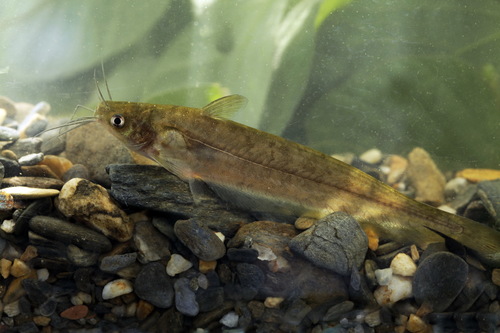
Rendahl's Catfish
Porochilus rendahli
A hidden gem of Australia's northern waterways, Rendahl's Catfish is an elegant, eel-tailed specialist of the night. This shy bottom-dweller uses its delicate whiskers to navigate a world of shadows and submerged forests.
Quick Identification
Size
Up to 20 cm (8 inches) in length; typically weighs less than 150g (5 oz).
Colors
Pale yellowish-brown to olive-grey on the back and sides, fading to a creamy white or silver belly.
Key Features
- Slender, elongated body with a continuous eel-like tail
- Four pairs of sensory barbels around the mouth
- Small eyes positioned high on the head
- Lack of distinct patterns or spots on the body
When You’ll See Them
Behavior
In their natural environment, they are relatively social, often congregating in loose groups where cover is abundant. They are not aggressive fish and tend to flee at the first sign of a larger predator. When foraging, they use their highly sensitive barbels to detect vibrations and chemical signals from prey hidden in the substrate, making them efficient hunters even in complete darkness or turbid water.
EverydayEarth exclusive
Camera Tips
Since this species is strictly nocturnal, the quality of your camera's infrared (IR) or white-light LEDs is critical. IR is preferred as it is less likely to spook the fish. Set your camera to video mode rather than stills; a 20-second clip will better capture their 'eel-like' undulations, which is their most defining visual characteristic. Ensure the lens is focused for close-range shots, as water clarity often limits visibility to just a few feet at night.
Using a lure is the most effective way to bring Rendahl's Catfish into the frame. A small mesh bag or a perforated canister filled with oily bait, such as canned tuna in spring water or crushed prawns, works wonders. Secure the bait approximately 12 inches in front of the lens. This not only draws them in but keeps them in the focal zone while they investigate the scent with their barbels.
Be mindful of water turbidity. If there has been recent heavy rain, wait for the sediment to settle before deploying your camera. In murky water, the light from the camera will reflect off suspended particles, creating a 'snowstorm' effect that obscures the fish. The best footage is usually captured during the dry season when the water is clear and the fish are concentrated in smaller areas.
Frequently Asked Questions
Record Rendahl's Catfish at your habitat
Connect a camera to start building your own species record — AI identifies every visitor automatically.