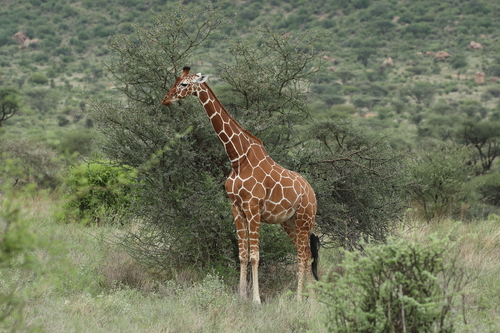
Reticulated Giraffe
Giraffa reticulata
Meet the Reticulated Giraffe, the savanna's most striking geometric masterpiece. Standing up to 20 feet tall, these 'Somali giraffes' are the tallest land mammals on Earth and a true icon of the African wild.
Quick Identification
Size
Height: 4.7–6 metres (15–20 feet); Weight: 800–1,200 kg (1,800–2,600 lbs)
Colors
Deep liver-red to chestnut-brown polygonal spots separated by narrow, bright white lines; patterns are unique to each individual
Key Features
- Crisp, block-like geometric coat pattern extending to the hooves
- Prehensile blue-black tongue reaching up to 18 inches
- Towering height of up to 20 feet
- Large, expressive eyes with long lashes
When You’ll See Them
Sightings on EverydayEarth
Jul 2, 2026
A Reticulated Giraffe stands partially obscured by vegetation while browsing on the leaves of a tall green bush. Its characteristic network of bright white lines against a rich chestnut background is highly visible as it reaches into the canopy.
Jul 2, 2026
A Reticulated Giraffe is observed walking through the scrubland in the background, moving from right to left behind a large watering hole. The foreground consists of a quiet pond with several large rocks or submerged logs, and the surrounding terrain is dry savanna woodland.
Jul 2, 2026
A peaceful morning scene at a watering hole in Laikipia. A hippopotamus surfaces briefly in the river, creating ripples on the water's surface. In the foreground, a Black-crowned Night Heron is perched motionless on a large rock. In the far distance, several giraffes can be seen walking across the dry, scrubby hillside.
Jun 28, 2026
Two Reticulated Giraffes are observed navigating a brushy hillside. They move slowly through the dense vegetation, likely browsing as they travel across the terrain.
Jun 28, 2026
Three Reticulated Giraffes are browsing on a lush, vegetated hillside. One individual is positioned slightly ahead of the other two, who stand close together further up the slope. They appear calm and alert, occasionally moving their long necks to survey the woodland environment.
Jun 26, 2026
A reticulated giraffe stands near the edge of a brown, murky river. It remains mostly still, scanning the woodland environment while occasionally flicking its tail to deter insects.
Geographic range
Where Does the Reticulated Giraffe Live?
The Reticulated Giraffe is a native treasure of the Horn of Africa, with its primary population stronghold located in northern and central Kenya. While they were historically found across broader stretches of the region, their current range is concentrated in the dry rangelands of the Laikipia, Samburu, and Marsabit counties. Isolated and smaller populations may still persist across the borders in southern Ethiopia and southwestern Somalia, though these populations are significantly smaller than the Kenyan heartland.
Basemap © OpenStreetMap contributors
Recorded on EverydayEarth
Behavior
Reticulated Giraffes are social giants, typically moving in loose associations known as 'towers' or 'journeys.' They are highly nomadic, traversing vast stretches of savanna in search of food. Unlike many social mammals, their groups are fluid and lack a strict hierarchy, though dominant males will occasionally engage in 'necking'—a graceful yet powerful display of strength using their long necks as clubs to establish breeding rights.
These animals are primarily diurnal, spending nearly 75% of their daylight hours browsing for nutrients. They have a peaceful relationship with humans, often becoming accustomed to eco-tourism vehicles in Kenyan conservancies, though they remain naturally wary of predators like lions and hyenas. Their extreme height allows them to act as the savanna's sentinels, spotting danger from miles away and inadvertently alerting other species to approaching threats.
EverydayEarth exclusive
Camera Tips
Capturing a Reticulated Giraffe on camera requires a strategy that accounts for their immense scale. Standard chest-high camera placements often result in footage of just legs and bellies. To get a full-body shot, mount your camera at least 2.5 to 3 meters (8–10 feet) high on a sturdy tree branch or pole, angling the lens downward at approximately 30 degrees. This 'bird's eye' perspective provides a majestic view of their geometric coat patterns and ensures the head and neck are in the frame as they pass by.
Alternatively, a 'low-angle' approach can produce dramatic, cinematic results. Secure the camera near the ground (protecting it from curious hooves with a reinforced security box) and point it upward toward the canopy. This perspective emphasizes their incredible height against the sky. Because giraffes are attracted to mineral licks and permanent water sources, especially during the dry season, placing cameras near known watering holes or salt-rich soil patches is the most effective way to guarantee a sighting. They are also creatures of habit, often using the same well-worn game trails between preferred acacia groves.
For camera settings, prioritize a high shutter speed. Even though giraffes appear to move gracefully and slowly, their long limbs cover distance quickly, which can cause significant motion blur in lower-end cameras. If your device supports it, use a wide-angle lens setting to fit as much of the animal into the frame as possible. Since they are most active during the 'golden hours' of dawn and dusk, ensure your camera has a high-quality sensor for low-light conditions to capture the rich reds of their coat without losing detail to digital noise.
Frequently Asked Questions
Record Reticulated Giraffe at your habitat
Connect a camera to start building your own species record — AI identifies every visitor automatically.