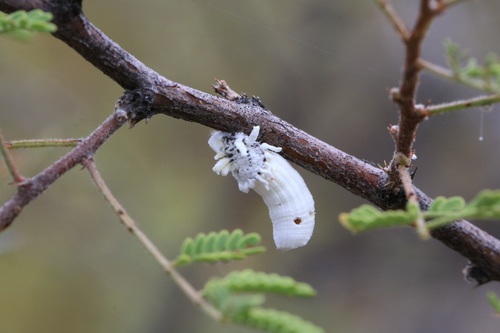
Riley's Giant Scale Insect
Crypticerya rileyi
A marvel of desert adaptation, Riley's Giant Scale Insect wears a protective coat of fluted wax to thrive in the heat. Often found on mesquite trees, these 'living ornaments' play a vital role in the complex web of desert life.
Quick Identification
Size
Adult females 4-8 mm (0.15-0.31 in) in length, excluding the waxy ovisac which can double their size.
Colors
Bright reddish-orange or brownish body, typically obscured by thick, white to pale yellow fluted wax secretions.
Key Features
- Thick, white fluted waxy covering
- Reddish-orange body visible underneath wax
- Found primarily on woody stems of Mesquite and Acacia
- Produces visible droplets of sticky honeydew
When You’ll See Them
Geographic range
Where Does the Riley's Giant Scale Insect Live?
Riley's Giant Scale Insect is native to the North American continent, specifically localized within the arid regions of the Southwestern United States and Northern Mexico. It is most frequently encountered throughout the Sonoran and Chihuahuan deserts, with high population densities found in Arizona, Texas, and New Mexico. This species thrives wherever its host plants, such as the honey mesquite, are prevalent in both wild and suburban environments.
Basemap © OpenStreetMap contributors
Behavior
Riley's Giant Scale Insect is a specialized sap-sucker that spends the majority of its life cycle anchored to the stems and branches of host trees. Unlike many insects that flit about, the adult female is largely sedentary, using her piercing-sucking mouthparts to tap into the phloem of desert legumes. As they feed, they process massive quantities of plant sap to extract nitrogen, excreting the excess sugar as a sticky substance called honeydew. This honeydew often attracts 'farming' ants, who protect the scale insects from predators in exchange for the sugary meal.
These insects are most famous for their elaborate waxy secretions. The wax serves as a multi-purpose tool: it prevents the insect from drying out in the intense desert heat, provides a physical barrier against small predators, and acts as a cradle for their eggs. While they may look like a fuzzy fungus or a bit of bird dropping to the untrained eye, a closer look reveals a complex, living organism perfectly adapted to the arid Southwest.
EverydayEarth exclusive
Camera Tips
Capturing Riley's Giant Scale Insect requires a shift in strategy compared to filming mobile wildlife. Because these insects are stationary, they are the perfect subjects for high-magnification macro photography or time-lapse videos. Set your AI-powered camera to its closest focusing distance and mount it on a stable branch or tripod aimed at a colony on a Mesquite or Acacia stem. Look for areas on the tree where you see ant activity, as ants are almost always present where scale insects are feeding.
To capture truly unique behavior, use a time-lapse setting with intervals of 30 to 60 seconds. This will allow you to see the 'pulsing' of the insects as they feed and the rapid-fire movement of ants harvesting honeydew. Lighting is critical; because the insects are often tucked under branches or in shadows, using a small, diffused LED light can help highlight the intricate textures of their white waxy fluting without washing out the detail.
During the late spring and early summer, keep an eye out for 'crawlers'—the tiny, mobile nymphs. These are much harder to spot but offer a fascinating look at the species' dispersal. If your camera has a trigger-based recording, set the sensitivity high, as the movement of the symbiotic ants will often be what triggers the recording, giving you a front-row seat to the ecological relationship between the two species.
Similar Species
Species that look similar or are commonly confused with Riley's Giant Scale Insect.
Frequently Asked Questions
Record Riley's Giant Scale Insect at your habitat
Connect a camera to start building your own species record — AI identifies every visitor automatically.