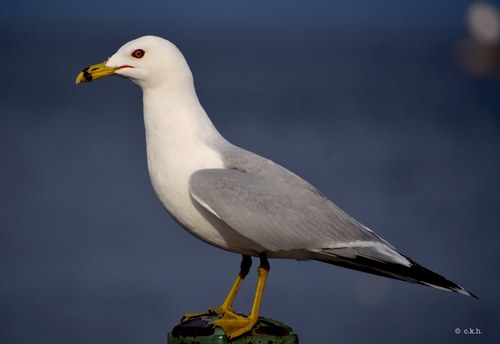
Ring-billed Gull
Larus delawarensis
The ultimate urban survivor, the Ring-billed Gull is a familiar face across North American lakes, parking lots, and shorelines. Known for its namesake bill marking and bold personality, this adaptable bird is a master of finding a meal in any environment.
Quick Identification
Size
Length: 17.5-21 in (45-54 cm); Wingspan: 41-46 in (105-117 cm); Weight: 11-25 oz (300-700 g)
Colors
White head, neck, and underparts with a light gray back and wings. Yellow legs and a yellow bill featuring a prominent black ring near the tip. Wingtips are black with distinct white spots.
Key Features
- Distinctive black ring encircling the yellow bill
- Bright yellow legs and feet
- Pale gray upperparts with black wingtips
- Medium-sized build, significantly smaller than a Herring Gull
When You’ll See Them
Behavior
Ring-billed Gulls are highly social and adaptable birds, often found in large colonies or mixed-species flocks. While they are often associated with the ocean, they are just as comfortable inland near lakes, rivers, and urban centers. They are exceptionally vocal, using a variety of high-pitched squeals, barks, and 'long calls' to communicate territory and food sources to the rest of the flock.
These gulls are incredibly comfortable around humans, often scavenging in parking lots, parks, and around outdoor eateries. They are opportunistic foragers, known to follow plows in farm fields to grab unearthed insects or snatch snacks directly from picnic tables. Despite their scavenger reputation, they are also skilled hunters of small fish and rodents, and they are frequently seen performing 'kleptoparasitism'—stealing food from other birds in mid-air.
EverydayEarth exclusive
Camera Tips
Capturing the Ring-billed Gull on a backyard or trail camera requires a focus on open spaces. Unlike woodland birds that seek cover, these gulls prefer flat, unobstructed areas where they have a clear line of sight and can easily take off. If you live near a lake or have a large open lawn, place your camera on a low tripod or a ground mount just 12-18 inches off the surface. Pointing the camera toward a flat rock or a patch of short grass where they typically congregate will yield the best 'eye-level' portraits, which are far more engaging than top-down shots.
To attract them specifically to your camera's field of view, use water as a lure. A large, shallow birdbath or even a simple drip system on the ground is irresistible to them for bathing and drinking. If you are using bait, small pieces of unsalted suet or dried mealworms scattered in a wide radius can keep them grounded and in frame longer. Avoid placing the camera too close to high-traffic human areas to prevent 'false triggers' from people, but don't be afraid to set up near a driveway or open patio where they already feel comfortable.
Technical settings are crucial because gulls are bright white and move quickly. If your camera allows for manual exposure, slightly underexpose the image (-0.5 or -1.0 EV) to prevent the white feathers from 'blowing out' and losing detail in bright sunlight. Use a fast shutter speed or 'blur reduction' mode to catch the sharp details of their wings during a takeoff. Because they are social, a wide-angle lens or a medium field of view is better than a tight zoom, as it allows you to capture the interactions between multiple birds in the flock.
Seasonally, look for them in late winter and early spring when they begin moving toward breeding colonies. During this time, they are more active and vocal. If your camera has a video or 'hybrid' mode, turn it on—the social squabbling and displays of the Ring-billed Gull make for fantastic audio-visual recordings that tell a much richer story than a still photo alone.
Similar Species
Species that look similar or are commonly confused with Ring-billed Gull.
Frequently Asked Questions
Record Ring-billed Gull at your habitat
Connect a camera to start building your own species record — AI identifies every visitor automatically.