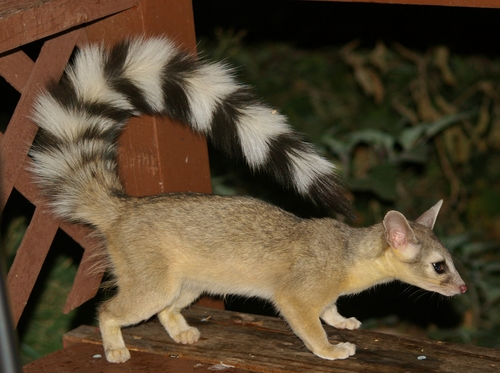
Ringtail
Bassariscus astutus
The Ringtail is the desert’s most acrobatic ghost, a wide-eyed relative of the raccoon that can scale vertical cliffs with ease. With its signature banded tail and cat-like grace, this elusive nocturnal hunter is a prize find for any backyard camera enthusiast.
Quick Identification
Size
Body length 12-17 in (30-42 cm); tail length 12-17 in (31-44 cm); weight 1.5-3.3 lbs (0.7-1.5 kg)
Colors
Buff to grayish-brown upper body with a creamy white underbelly; large dark eyes with white rings; striking tail with 14-16 alternating black and white rings.
Key Features
- Extraordinarily long tail with black and white rings
- Large, upright ears and dark, inquisitive eyes
- Slender, cat-like body with short legs
- Rotating hind ankles that allow for head-first climbing down trees
When You’ll See Them
Behavior
Often called the 'Miner's Cat,' the Ringtail is a shy, solitary member of the raccoon family that is rarely seen during the day. They are master acrobats, capable of scaling vertical walls, leaping between narrow ledges, and even 'stemming' up chimneys or crevices by pressing their feet against opposite walls. Their ankles can rotate 180 degrees, giving them unmatched agility in rocky terrain.
While they are generally reclusive, Ringtails are highly territorial and use vocalizations and scent marking to defend their home range. They are not true cats, but their sleek movement and expert hunting skills often lead to that comparison. In the wild, they lead busy nocturnal lives, spending their waking hours foraging for food and avoiding larger predators like owls and coyotes.
EverydayEarth exclusive
Camera Tips
Capturing a Ringtail on camera requires a strategy focused on vertical movement. Unlike most backyard mammals that stick to the ground, Ringtails prefer to travel along stone walls, fence tops, or low tree branches. Mount your camera 3 to 5 feet high and angle it toward rocky crevices or the top of a woodpile. If you have a stone chimney or an old outbuilding, these are prime 'highways' for a Ringtail patrolling its territory.
Because they are strictly nocturnal, your camera’s night vision is the most important setting. Use a 'No-Glow' or high-quality infrared flash to avoid startling these timid animals. Since they move with lightning-fast, jerky motions, set your camera to a fast shutter speed or use 'Burst Mode' to capture multiple frames. This increases your chances of getting a clear shot of that magnificent ringed tail rather than just a blurry tail-tip as they vanish into the shadows.
If you are struggling to spot one, you can use scent to pique their interest. A small amount of honey, dried apricots, or even peanut butter placed on a flat rock can encourage them to pause in front of the lens. Always place the lure in a spot where the camera has a clear, unobstructed view of the surrounding 5 feet, as they like to scout the area before approaching a food source.
Seasonally, late summer is a fantastic time for camera trapping as the young begin to forage with their mothers. During the dry months, placing a camera near a low-profile water basin in a rocky area is almost a guaranteed way to see them, as they must visit water sources frequently in their arid habitats. Be patient; their territories can be large, and it may take a week or two before one cycles back through your specific yard.
Similar Species
Species that look similar or are commonly confused with Ringtail.
Frequently Asked Questions
Record Ringtail at your habitat
Connect a camera to start building your own species record — AI identifies every visitor automatically.