Rivoli's Hummingbird
Eugenes fulgens
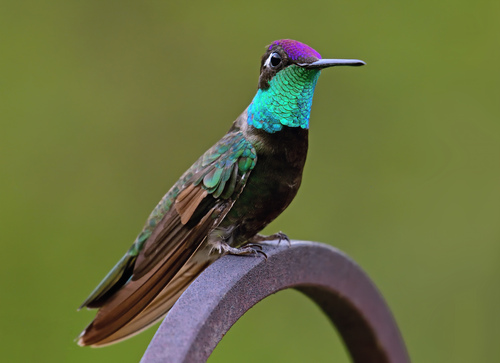
The 'Mountain Gem' of the Southwest, Rivoli's Hummingbird is a towering beauty of the avian world, sporting a regal purple crown and an emerald throat that shimmers like jewelry.
Quick Identification
Size
11-14 cm (4.3-5.5 in) long; 18 cm (7 in) wingspan; 6-10 g (0.2-0.35 oz) weight
Colors
Males feature a brilliant emerald-green throat and a royal purple crown with a dark bronze-green body. Females are more subdued with metallic green upperparts and salted-gray underparts.
Key Features
- One of the two largest hummingbird species in North America
- Distinctive white spot behind the eye on both sexes
- Male's iridescent purple cap and green gorget
- Long, straight black bill and slightly notched tail
When You’ll See Them
Behavior
The Rivoli's Hummingbird, formerly known as the Magnificent Hummingbird, carries an air of elegance that matches its old name. Despite their impressive size, they are remarkably graceful fliers. Unlike the hyper-aggressive smaller hummingbird species, Rivoli's are generally more placid at feeders. They often use their size to quietly dominate a feeding station without the frantic chasing seen in other species, though they will occasionally dive-bomb intruders if provoked.
In the wild, these birds are 'trap-liners,' meaning they follow a routine circuit of flowering plants rather than defending a single patch of blooms. They are highly efficient foragers, often seen hovering with steady, powerful wingbeats while extracting nectar. To humans, they are often approachable but maintain a dignified distance, frequently returning to a favorite high perch between foraging bouts to survey their surroundings.
EverydayEarth exclusive
Camera Tips
Capturing the Rivoli's Hummingbird on camera requires a focus on light and scale. Because their stunning purple and green colors are structural—meaning they only appear when light hits them at a specific angle—position your camera facing north or south. This ensures the sun is at a side angle or behind the camera for most of the day, which maximizes the 'fire' or iridescence of the male's throat and crown. A camera with a high frame rate is essential for these birds; aim for at least 60 frames per second to reduce wing blur, though their larger size makes them slightly easier to track than tiny species.
Since Rivoli's are significantly larger than the common Black-chinned or Broad-tailed hummingbirds, you should mount your camera 2 to 3 feet away from your feeder or flower cluster. If your camera is too close, you may lose part of the bird's impressive wingspan in the frame. Using a feeder with a perch is highly recommended; while they can hover perfectly well, these larger birds often prefer to land and rest while drinking, which provides a stable, long-duration shot for your AI to identify and record.
For the most natural-looking shots, try placing your camera near native nectar plants like Agastache (Hummingbird Mint) or Penstemon. If using a feeder, ensure it is a high-volume model, as these birds consume significantly more sugar water than their smaller cousins. Late afternoon is the golden hour for Rivoli's; the softening light often brings out the deep bronze tones in their feathers that are normally missed in harsh midday sun. Set your motion trigger sensitivity to high, as even a bird of this size moves with surprising speed when entering the frame.
Similar Species
Species that look similar or are commonly confused with Rivoli's Hummingbird.
Frequently Asked Questions
Record Rivoli's Hummingbird at your habitat
Connect a camera to start building your own species record — AI identifies every visitor automatically.