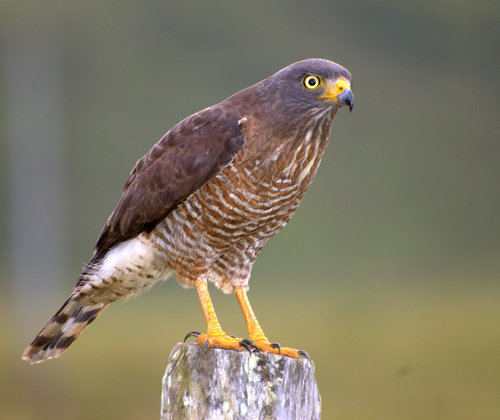
Roadside Hawk
Rupornis magnirostris
The Roadside Hawk is the bold, vocal sentinel of the Americas. Often seen perched on fence posts, this adaptable hunter is likely the most common raptor you'll spot in your backyard or on a country drive.
Quick Identification
Size
Length of 31-41 cm (12-16 inches); wingspan of 70-80 cm (28-31 inches); weight ranges from 250-350g (9-12 oz).
Colors
Gray-brown upperparts with a streaked throat; breast and belly feature distinctive horizontal rufous (reddish-brown) barring; tail has broad gray and black bands; bright yellow eyes, cere, and legs.
Key Features
- Distinctive rufous patches on primary wing feathers visible in flight
- Horizontal reddish-brown barring on the underparts
- Bright yellow cere, legs, and iris
- Relatively long tail with 4-5 dark bands
When You’ll See Them
Geographic range
Where Does the Roadside Hawk Live?
The Roadside Hawk is a quintessential Neotropical species, native to a massive range extending from southern Mexico and Central America through most of South America to northern Argentina. It is widely considered the most common hawk across its core range in countries like Brazil, Colombia, and Costa Rica, flourishing in almost any habitat except for the densest, unbroken rainforest or the highest peaks of the Andes. Its ability to thrive in human-altered landscapes has allowed it to remain a dominant presence across the continent.
Basemap © OpenStreetMap contributors
Behavior
Roadside Hawks are remarkably bold and vocal raptors, often seen perched conspicuously on fence posts, telephone wires, or low branches. Unlike many shy birds of prey, they have adapted exceptionally well to human presence and are frequently spotted along roadsides and in suburban gardens. Their piercing, high-pitched 'kee-eee-ee' whistles are a hallmark of their territory, especially during the breeding season when they become highly defensive of their nests.
These birds are opportunistic hunters that utilize a sit-and-wait strategy. They spend much of their day surveying the ground from a low perch, dropping down suddenly to snatch prey with their sharp talons. While they are usually solitary or found in pairs, they are intelligent enough to follow swarms of army ants or even grass fires to catch insects and small animals fleeing the disturbance.
EverydayEarth exclusive
Camera Tips
To capture high-quality footage of a Roadside Hawk, position your AI-powered camera near prominent, isolated perches such as fence posts, dead snags, or low-hanging branches at the edge of an open clearing or backyard. These hawks prefer perches between 5 and 15 feet off the ground where they have an unobstructed view of the grass. Point your camera slightly upward if the perch is high, or use a wide-angle setting to monitor a specific 'launch point' they use for hunting.
While you should never use live bait, these hawks are often attracted to backyards with high activity from large insects or lizards. Placing a camera near a large, flat water feature or bird bath in a sun-exposed area can be very effective; Roadside Hawks frequently visit to drink or bathe during the heat of the afternoon. Ensure your camera has a very fast trigger speed, as their strike from a perch to the ground is lightning-fast and over in a second.
For camera settings, prioritize a high shutter speed or 'Sports Mode' to reduce motion blur during takeoff and landing. Because they are active during the brightest parts of the day, ensure the camera lens isn't facing directly into the morning or afternoon sun to avoid lens flare. If you're using a trail camera, a 3-shot burst mode or a 15-second video trigger is ideal for capturing the sequence of the hawk landing, scanning the area, and departing with prey.
Similar Species
Species that look similar or are commonly confused with Roadside Hawk.
Broad-winged Hawk
Broad-winged Hawks have shorter tails and lack the distinctive rufous wing patches and heavy belly barring of the Roadside Hawk.
Red-shouldered Hawk
Red-shouldered Hawks are larger with more translucent 'windows' at the wingtips rather than the solid rufous patches seen on the Roadside Hawk.
Frequently Asked Questions
Record Roadside Hawk at your habitat
Connect a camera to start building your own species record — AI identifies every visitor automatically.