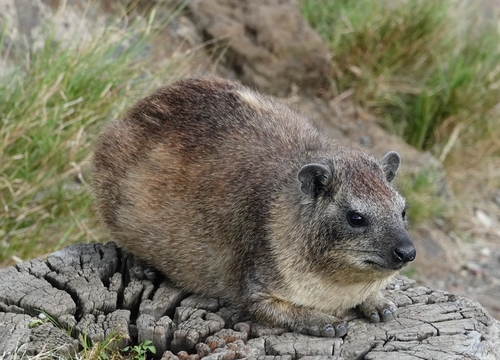
Rock Hyrax
Procavia capensis
Meet the 'Dassie,' the small, furry rock-dweller that counts the elephant as its closest living cousin. These social sun-worshippers are the masters of the rocky outcrop, bringing a touch of ancient wildness to suburban gardens.
Quick Identification
Size
30–58 cm (12–23 in) in length; weighs 4–5 kg (8.8–11.0 lb)
Colors
Dull brownish-grey fur with paler undersides; a distinctive patch of black or yellowish hair covers a scent gland on the back.
Key Features
- Stocky, tailless body with a marmot-like appearance
- Short, rounded ears and blunt snout
- Three-toed front feet and four-toed back feet with flat, hoof-like nails
- Prominent dorsal scent gland often marked by a different hair color
When You’ll See Them
Sightings on EverydayEarth
Jun 28, 2026
Two Rock Hyraxes are huddled together on a flat rock outcrop within a watering hole. One animal remains still while the other shifts its weight and turns its head, looking out over the water in the darkness.
Jun 24, 2026
Three Rock Hyraxes are resting on a rocky outcrop near a stone wall. One individual is tucked into the shade against the wall, while the other two are out in the open, occasionally shifting their positions and scanning the area.
Jun 18, 2026
A Rock Hyrax scuttles through the sun-drenched grass, pausing occasionally to sniff the ground and forage before moving further into the undergrowth.
Jun 6, 2026
Two Rock Hyraxes are active in the nighttime scene: one sits motionless on the rocks in the foreground, while another is seen foraging on the grassy bank across the water. Faint eye shine is also visible reflecting from the water's surface.
May 21, 2026
A Rock Hyrax is perched on a weathered tree stump, turning its head to scan the environment. The camera then pans across the verdant landscape, revealing a small herd of domestic cattle grazing near the trees in the distance.
May 20, 2026
A Rock Hyrax is seen perched on a rock near the water's edge in the darkness. It remains mostly stationary, looking around briefly before the camera shifts its position.
Behavior
Rock Hyraxes, affectionately known as 'dassies' in many regions, are highly social animals that live in colonies of up to 50 individuals. They are famously known as the closest living relatives to elephants, a fact evidenced by their unique teeth and bone structure. Despite this grand lineage, they spend much of their day engaging in the simple pleasure of sun-basking. Because they have a poor ability to regulate their body temperature, you will often spot them huddled together on warm rocks during the morning hours to soak up the heat.
Within the colony, there is a clear social hierarchy, usually led by a dominant male who keeps a watchful eye for predators like eagles or caracals. When danger is near, the sentry lets out a sharp, barking alarm call that sends the entire group scurrying into the safety of rock crevices. In suburban areas, they can become quite bold, frequently visiting gardens to graze on succulents or lawn grass, though they remain wary of sudden movements.
EverydayEarth exclusive
Camera Tips
To capture the best footage of Rock Hyraxes, position your camera near prominent, flat-topped rocks that face the morning sun. These are their primary 'basking stations' where they congregate to warm up after a cold night. Set the camera at a low height—roughly 12 to 18 inches off the ground—and angle it slightly upward to capture their full profile against the rock surface. Since they are social, a wide-angle lens is preferable to capture the interactions between colony members.
Rock Hyraxes are creatures of habit and often use the same paths to move between their sleeping crevices and their feeding grounds. Look for 'latrines'—areas with white calcium carbonate staining on the rocks—as these are high-traffic zones. Placing a camera near these spots ensures regular sightings. While they don't require traditional bait, a shallow water bowl or a salt lick placed nearby during dry months can act as a significant draw for the entire colony.
Because they are diurnal and highly active in bright light, ensure your camera’s shutter speed is fast enough to avoid motion blur during their quick scurrying movements. If your camera supports burst mode, use it; capturing the sequence of a hyrax yawning (showing off its tusk-like incisors) or the dominant male letting out an alarm call makes for incredible footage. During the breeding season, keep an eye out for 'pups'—the young are born fully furred with their eyes open and are active on the rocks within hours of birth.
Frequently Asked Questions
Record Rock Hyrax at your habitat
Connect a camera to start building your own species record — AI identifies every visitor automatically.