Rock Pigeon
Columba livia
The world's most famous urban adventurer, the Rock Pigeon is a master of adaptation with stunning iridescent plumage and a complex social life. From city skyscrapers to suburban patios, these intelligent birds turn every backyard into a bustling community hub.
Quick Identification
Size
Length: 29–37 cm (11–15 in); Wingspan: 62–72 cm (24–28 in); Weight: 238–380 g (8.4–13.4 oz)
Colors
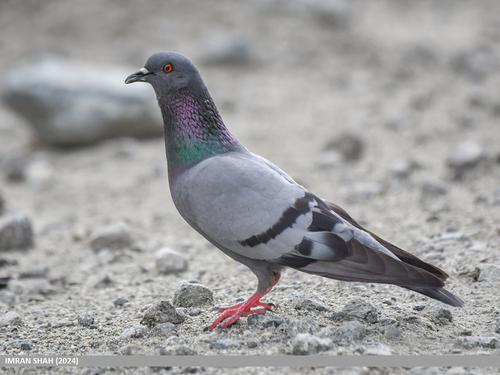
Varied plumage due to domestication; typically bluish-gray with two black wing bars, a white rump, and iridescent green/purple neck feathers. Feet are reddish-pink.
Key Features
- Two dark bars on each wing
- Iridescent green and purple patches on the neck
- White rump patch visible in flight
- Thick, rounded body with a small head and short legs
When You’ll See Them
Sightings on EverydayEarth
Apr 4, 2026
Under the glow of infrared lighting, two penguins rest on the rocky ledges of their habitat. In the center, a group of pigeons is active, hopping across the pebble-covered floor and foraging for leftover food.
Apr 1, 2026
A Magellanic Penguin stands prominently in the center of the rocky nesting area, occasionally turning its head to survey the surroundings. On the left side of the frame, a Rock Pigeon walks across the enclosure, moving from the foreground toward the background rocks.
Behavior
Rock Pigeons are highly social birds that are almost always found in flocks. They are famous for their unique 'head-bobbing' walk, which helps stabilize their vision as they move. Unlike most birds that have to tilt their heads back to swallow water, pigeons can keep their beaks submerged and suck up water, allowing them to drink much more efficiently in open areas.
In backyard settings, they are bold and opportunistic, often becoming the dominant species at ground-level feeders. They communicate through a series of soft, throaty coos, especially during courtship when males puff out their neck feathers and strut in circles. Despite their reputation as 'city birds,' they are remarkably intelligent and possess an incredible homing ability, navigating via magnetic fields and landmarks.
EverydayEarth exclusive
Camera Tips
To capture high-quality footage of Rock Pigeons, you must focus on the ground. These birds are natural foragers and rarely use hanging tube feeders. Place your AI-powered camera 6 to 12 inches off the ground, angled slightly upward. If you use a platform or tray feeder, mount the camera at the same level as the tray to capture the intricate details of their iridescent neck feathers, which can 'wash out' or look dull if the lighting is too harsh or the angle is too high.
Because Rock Pigeons usually travel in groups, your camera will likely trigger frequently once a flock finds your yard. To avoid a thousand identical clips of the same flock, we recommend setting a 'cool-down' period of 3-5 minutes between recordings. To get the best action shots, use a camera with a high shutter speed or 'Burst Mode,' as their take-offs are sudden and powerful. Providing a shallow, wide birdbath is an excellent secondary lure; pigeons are frequent bathers and watching a flock splash together provides great entertainment.
If you are looking for more 'natural' looking shots away from human structures, place your camera near an open patch of gravel or dirt. Pigeons often congregate in these areas to swallow small stones (grit), which helps them digest seeds. For the most vibrant colors, try to position your setup so the sun is behind the camera during the morning hours; this light hits the iridescent throat feathers perfectly, turning them from drab gray into brilliant metallic greens and magentas on screen.
Similar Species
Species that look similar or are commonly confused with Rock Pigeon.
Mourning Dove
Smaller and slimmer with a long, pointed tail; lacks the iridescent neck patches and white rump of the Rock Pigeon.
Band-tailed Pigeon
Found in the Western US; has a yellow bill and a distinct white crescent on the back of the neck.
Eurasian Collared-Dove
Paler gray-tan overall with a thin black 'collar' around the back of the neck and a squared-off tail.
Frequently Asked Questions
Record Rock Pigeon at your habitat
Connect a camera to start building your own species record — AI identifies every visitor automatically.