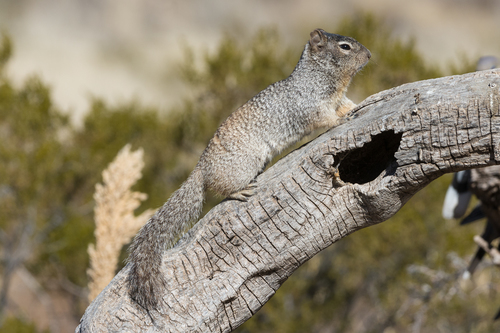
Rock Squirrel
Otospermophilus variegatus
The rock squirrel is the rugged climber of the Southwest, more at home on a canyon wall than a tree branch. With their mottled coats and piercing alarm whistles, they bring a sense of wild, high-desert character to any backyard stone wall.
Quick Identification
Size
17 to 21 inches (43–53 cm) in total length; weighs approximately 1.1 to 1.8 lbs (500–800 g)
Colors
Mottled grayish-brown fur with white speckling; head and shoulders often appear darker or even blackish, while the underbelly is buff or light brown
Key Features
- Large, bushy tail with white-tipped hairs
- Mottled 'salt and pepper' fur pattern
- White ring around each eye
- Long, sharp claws adapted for climbing stone surfaces
When You’ll See Them
Sightings on EverydayEarth
May 20, 2026
An Inca Dove is perched on the rocky rim of the water basin before flying out of view. Simultaneously, a Rock Squirrel approaches from the right, navigating the rocks and dry branches to reach the water's edge and begin drinking.
Apr 10, 2026
A Rock Squirrel is seen drinking from the edge of a rocky pool. It moves cautiously along the stones before settling on the lower-left side. In the background, a Mexican Jay perches on a weathered branch on the right side of the frame.
Behavior
Rock squirrels are among the most social and terrestrial members of the squirrel family in the Southwest. Unlike their tree-dwelling cousins, they are master navigators of vertical stone, often living in loose colonies where a dominant male defends a territory containing several females. They are famously alert, frequently seen standing perfectly upright on their hind legs atop a 'scout' rock to scan for predators. If a hawk or coyote is spotted, they let out a high-pitched, piercing whistle to warn the rest of the group before diving into a nearby crevice.
In backyard settings, these squirrels are remarkably bold and opportunistic. They are known for their architectural skills, often digging complex burrow systems underneath stone walls, patios, or woodpiles. While they primarily forage on the ground, they are surprisingly agile climbers and won't hesitate to scale a bird feeder or a low-hanging fruit tree. Their activity follows a seasonal rhythm; in warmer desert climates, they may stay active year-round, but in higher elevations, they enter a deep sleep (estivation or hibernation) during the harshest months.
EverydayEarth exclusive
Camera Tips
To capture high-quality footage of a rock squirrel, you need to identify their 'sentinel stones.' These are prominent, flat-topped rocks or wall sections where the squirrels sit to sun themselves and watch for danger. Mounting your camera about 12 to 18 inches off the ground and angling it slightly upward toward one of these stones is the best way to get that classic 'hero shot' of them standing on their hind legs. If your camera has a wide-angle lens, place it approximately 4 to 6 feet away from a suspected burrow entrance—usually a hole tucked under a rock or concrete slab—to ensure you capture their full body and bushy tail as they emerge.
Baiting is highly effective for this species. A handful of black oil sunflower seeds, unsalted peanuts, or even a sliced apple placed on a 'stage' rock will keep them in the frame long enough for a great video. Because they are twitchy and fast, set your camera to its fastest trigger speed and choose a video length of 15–20 seconds. This allows you to observe their fascinating manual dexterity as they use their forepaws to manipulate food or stuff their cheek pouches to the limit.
Lighting is a key consideration for the rock squirrel’s mottled fur. Their coat is designed to blend into dappled shadows and grey stone, which can sometimes look 'flat' on camera. Try to position your camera so the morning sun hits the foraging area from the side; this side-lighting highlights the texture of their fur and the fluffiness of their tail. In the heat of mid-summer, they often take 'siestas' to avoid the midday sun, so focus your monitoring efforts on the two hours after sunrise when they are most active and the light is golden.
Similar Species
Species that look similar or are commonly confused with Rock Squirrel.
California Ground Squirrel
Very similar in appearance but has a more distinct 'cape' of darker fur on its back and is generally found closer to the Pacific coast.
White-tailed Antelope Squirrel
Much smaller with a prominent white stripe on its side and a tail that it often carries curled over its back.
Frequently Asked Questions
Record Rock Squirrel at your habitat
Connect a camera to start building your own species record — AI identifies every visitor automatically.