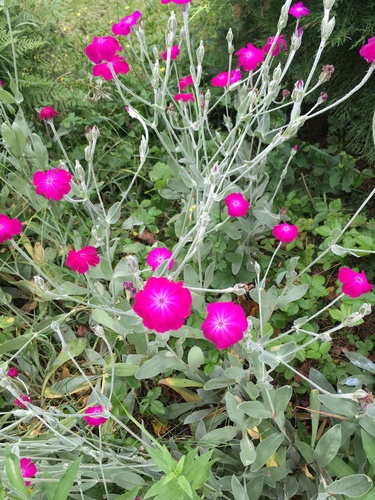
Rose campion
Silene coronaria
With its striking neon-pink blooms and velvet-soft silvery foliage, the Rose Campion is a timeless garden classic that brings a touch of 'moonlight' glow to any sunny backyard.
Quick Identification
Size
60-90 cm (2-3 ft) tall, 30-45 cm (1-1.5 ft) wide
Colors
Vibrant magenta or deep rose-pink flowers; foliage and stems are a striking silvery-white or pale grey
Key Features
- Silvery-grey woolly stems and leaves
- Vibrant five-petaled magenta flowers
- Upright, branching growth habit
- Soft, velvet-like texture on all green parts
When You’ll See Them
Geographic range
Where Does the Rose campion Live?
Native to the sun-drenched landscapes of Eurasia, Rose Campion originally hailed from Southeast Europe and Western Asia, extending as far as the Himalayas. This hardy traveler has since been introduced and naturalized across much of North America and the United Kingdom, where it is a staple of temperate gardens. It thrives particularly well in Mediterranean-like climates but is adaptable enough to flourish in suburban settings and wild meadows across most of the United States and Southern Canada.
Basemap © OpenStreetMap contributors
Behavior
These plants are remarkably drought-tolerant and thrive in poor soil, making them a favorite for low-maintenance cottage gardens. While they are stationary, they act as a social hub for the backyard, attracting a wide variety of pollinators. They are also famous for being 'prolific self-seeders,' meaning they will often wander around your garden over the years, popping up in sunny spots where they weren't originally planted.
EverydayEarth exclusive
Camera Tips
To capture the stunning contrast of Rose Campion on your AI-powered backyard camera, position your device at a low angle, roughly 12 to 18 inches off the ground. This 'bug's eye view' highlights the architectural beauty of the silvery stems against the backdrop of the sky or darker garden foliage. Because the magenta flowers are so intense, they can sometimes appear 'blown out' or oversaturated in direct midday sun; try to angle the camera so the plants are backlit during the golden hours of morning or late afternoon for an ethereal, glowing effect.
While the plant itself is stationary, it is a high-traffic hub for pollinators. To capture wildlife interactions, set your camera to a high-speed trigger or 'Burst Mode.' This will allow you to catch clear frames of bumblebees, clearwing moths, and butterflies as they hover around the tubular blooms. Since Rose Campion is a taller, somewhat spindly plant, ensure your camera is secured to a sturdy stake rather than a flexible branch to prevent wind-induced false triggers from the swaying flower heads.
For the best results, use a macro lens attachment if your camera supports it, or set your focus range to 'Close' to ensure the fine, woolly hairs of the foliage are crisp and detailed. During the summer peak, these plants are most 'active' with visitors between 10 AM and 2 PM. If you are looking for nocturnal visitors, you might even catch a glimpse of various moth species drawn to the pale foliage and nectar in the twilight hours.
Finally, consider the background. Because Rose Campion is silver-grey, it pops best against a dark green backdrop or a wooden fence. Avoid placing the camera where it faces a white wall, as the silver foliage may blend in too much. If you are using an AI camera with animal detection, the movement of pollinators against the bright magenta flowers provides an excellent trigger point for high-quality video clips.
Frequently Asked Questions
Record Rose campion at your habitat
Connect a camera to start building your own species record — AI identifies every visitor automatically.