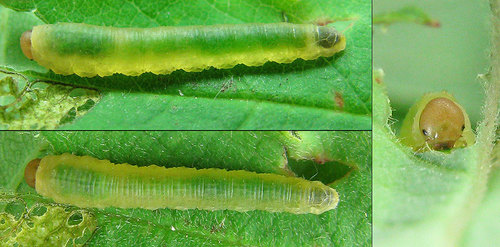
Rose Slug Sawfly
Endelomyia aethiops
A master of disguise in the rose garden, the Rose Slug Sawfly larva looks like a shimmering drop of moss-green slime. This tiny 'skeletonizer' is a common find for backyard naturalists with a keen eye for detail.
Quick Identification
Size
Adults: 5-6 mm (0.2 in) long; Larvae: 12-15 mm (0.5-0.6 in) long
Colors
Adults are glossy black with darkened wings; larvae are translucent lime-green with a distinct amber or yellowish-orange head.
Key Features
- Slime-covered, slug-like appearance in larval stage
- Translucent green body that blends with foliage
- Yellowish or orange-tinted head capsule
- Ten pairs of prolegs visible on the underside
- Leaves distinctive 'windowpane' damage on rose leaves
When You’ll See Them
Behavior
The Rose Slug Sawfly is a fascinating garden resident that is far more often seen than its adult counterpart. Despite the name, these are not slugs at all, but the larvae of a primitive type of wasp. They are famous for their unique feeding style known as 'skeletonizing.' Rather than chewing through the entire leaf like a caterpillar, the larvae graze on the soft green tissue on the underside of the leaf, leaving behind a thin, transparent layer of cells and the structural veins.
As adults, these sawflies are solitary and relatively inconspicuous, looking like tiny, shiny black flies as they dart among the rose canes to lay their eggs. They do not sting humans and are generally harmless to everything except your prize-winning roses. In the backyard ecosystem, they serve as a vital food source for predatory wasps, beetles, and small songbirds who frequent the garden looking for a protein-rich snack.
EverydayEarth exclusive
Camera Tips
To capture the Rose Slug Sawfly, you need to think small and get close. These insects are tiny, so a standard trail camera distance won't cut it. Use a macro lens attachment or set your camera to its closest focusing distance (macro mode). Mount your camera on a small flexible tripod and position it just 4-8 inches away from a rose leaf that shows signs of 'windowpane' damage—where the leaf looks like it has clear or brown translucent patches.
Placement is everything with this species. Don't aim your camera at the top of the leaf; instead, angle it to look at the underside. Rose slugs are photophobic, meaning they prefer to hide from the direct sun and predators by clinging to the bottom of the foliage. If you can find a leaf that is slightly shaded but has bright light behind it, you can capture incredible 'X-ray' style footage where the larva's internal organs are visible through its translucent green skin.
For the best results, set your camera to record short, high-resolution video clips rather than still photos. The movement of the Rose Slug Sawfly is very slow and rhythmic, almost like a real slug, and video captures this behavior much better than a static image. Because they are most active during the warmer parts of the day, ensure your camera is positioned to avoid direct glare on the lens which can wash out the subtle green colors of the larva.
If you are using an AI-powered camera, you might find that the small size of the insect doesn't always trigger the motion sensor. In this case, use a time-lapse setting, taking one photo every 30 seconds to a minute. This will allow you to see the 'skeletonizing' process in fast-forward, providing a unique look at how these tiny creatures can transform a garden leaf in just a few hours.
Similar Species
Species that look similar or are commonly confused with Rose Slug Sawfly.
Frequently Asked Questions
Record Rose Slug Sawfly at your habitat
Connect a camera to start building your own species record — AI identifies every visitor automatically.