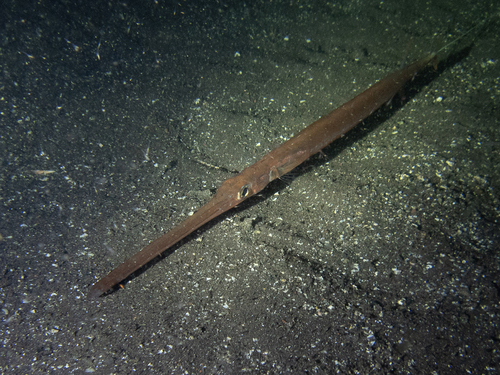
Rough Flutemouth
Fistularia petimba
The Rough Flutemouth is a marvel of marine evolution, featuring a body as thin as a reed and a snout designed for high-speed vacuum feeding. This elusive deep-water hunter uses perfect camouflage to drift unseen through the world's tropical oceans.
Quick Identification
Size
Typically 1 to 1.5 metres (3.3 to 5 feet), though rare specimens can reach up to 2 metres (6.6 feet).
Colors
Deep reddish-orange to brownish-red overall; they possess a distinct row of bony plates along the midline of the back which are often darker in color.
Key Features
- Extremely elongated, tubular body with a very long snout
- Filamentous tail extension projecting from the center of the tail fin
- Rough skin texture with bony plates along the dorsal midline
- Small mouth at the tip of the snout capable of rapid expansion
When You’ll See Them
Geographic range
Where Does the Rough Flutemouth Live?
The Rough Flutemouth is a widely distributed marine species found in the subtropical and tropical reaches of the Atlantic, Indian, and Pacific Oceans. It is native to the Indo-Pacific region, stretching from the coast of East Africa to the shores of Central America, and it is a common sight in the waters surrounding Japan and Northern Australia. In the Atlantic, its range extends from the southern United States down to Argentina, as well as along the western coast of Africa, thriving in deeper shelf waters where temperatures remain stable.
Basemap © OpenStreetMap contributors
Behavior
The Rough Flutemouth is a master of stealth and patience in the marine environment. Unlike many reef fish that dart about, this species is often observed hovering almost motionless in the water column, often at a slight angle or vertically to mimic floating debris or seagrass. This mimicry allows it to approach unsuspecting prey or wait for small fish to swim within range of its specialized snout.
While they are generally solitary hunters, they can sometimes be found in small, loose groups near deep rocky reefs or shipwrecks. They are not particularly aggressive toward humans but are known for being wary; they will slowly drift away if they feel a diver or an underwater camera is approaching too quickly. Their social structure is minimal, focusing primarily on efficient, low-energy ambush predation.
EverydayEarth exclusive
Camera Tips
Capturing the Rough Flutemouth requires a specialized underwater camera housing or a dedicated marine trail camera. Since this species prefers depths starting around 10 meters, you should look for locations where rocky reefs or drop-offs are accessible. Mounting your camera on a stable tripod at the base of a reef structure is the best way to get a clear, steady shot, as these fish often hover just above the seabed to scan for prey.
Because the Rough Flutemouth is reddish in color, it can appear grey or brown in deeper water as the red end of the light spectrum is absorbed by the ocean. To capture their true vibrant orange-red hue, use a red filter on your camera lens or provide artificial light using high-CRI (Color Rendering Index) underwater LEDs. Set your camera to a wide-angle view, as their extreme length makes it difficult to fit the entire fish in a standard frame when they swim close to the lens.
To attract a Rough Flutemouth to your camera site, try placing the camera near areas with high baitfish activity, such as small coral heads or artificial reef blocks. They are ambush predators and will naturally congregate where their food is plentiful. Using a slow-motion video setting (60fps or higher) is highly recommended; their 'vacuum strike' happens so fast that it is almost invisible to the naked eye, and slowing down the footage is the only way to see their snout expand as they feed.
Be mindful of the tide and water clarity. The best footage is usually captured during 'slack tide' when the water is clearest and there is less suspended sediment to trigger the camera's motion sensors unnecessarily. If you are setting a stationary camera, ensure it is weighted heavily or secured to a fixed structure, as ocean currents can easily shift equipment, ruining your framing of the reef edge where these fish like to patrol.
Frequently Asked Questions
Record Rough Flutemouth at your habitat
Connect a camera to start building your own species record — AI identifies every visitor automatically.