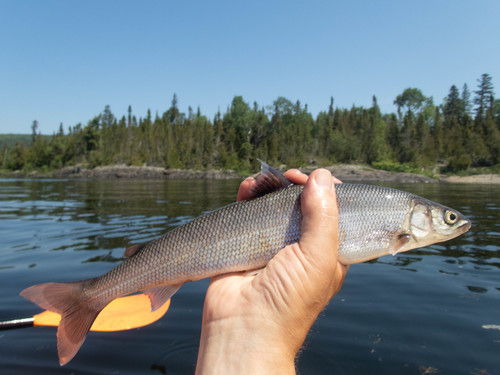
Round Whitefish
Prosopium cylindraceum
A sleek, silver-scaled resident of the deep, the Round Whitefish is a master of the lake bottom. Recognizable by its unique cigar-shaped body and pointed snout, this elusive fish is a hallmark of the pristine, cold waters of the North.
Quick Identification
Size
Length: 9-19 inches (23-48 cm); Weight: 0.5-4 lbs (0.2-1.8 kg)
Colors
Olive-brown to dark green back, bright silvery sides, and a white belly; no spotting on adults, though juveniles may have dark 'parr marks'.
Key Features
- Cylindrical, cigar-shaped body profile
- Small, sub-terminal mouth located under a pointed snout
- Bright silvery scales with an iridescent sheen
- Presence of a small adipose fin behind the dorsal fin
When You’ll See Them
Behavior
Round Whitefish, often locally known as 'Menominee,' are specialized bottom-dwellers that spend most of their lives in the cold, deep waters of northern lakes and rivers. Unlike many of their more social salmonid relatives, they tend to move in smaller, loose groups or as solitary individuals. They are generally shy and easily spooked by sudden vibrations or shadows, preferring the safety of deeper water during the bright midday hours.
These fish are most notable for their 'rooting' behavior, where they use their pointed snouts to sift through gravel and sand in search of food. During the late autumn months, usually between October and December, they undergo a significant behavioral shift as they move into shallower rocky shoals or up tributary streams to spawn. This is one of the few times they can be observed in relatively shallow water, often braving near-freezing temperatures to deposit eggs over rocky substrate.
EverydayEarth exclusive
Camera Tips
To capture the Round Whitefish on camera, you will need a submersible setup, as they rarely surface. If you have a dock or waterfront property on a clear northern lake, position your camera near a transition zone where a sandy bottom meets a rocky reef. Use a weighted tripod or a specialized underwater mount to keep the camera 1-2 feet off the lake bed, angling it slightly downward to capture their bottom-feeding activities or slightly upward to catch their silvery silhouettes against the surface light.
Timing is critical for this species; your best chance for high-quality footage is during the late fall spawning run. During this window, Round Whitefish move into water as shallow as 3-6 feet. Look for areas with clean, golf-ball-sized gravel. Set your camera's motion trigger to a high sensitivity, or better yet, use a continuous recording mode if power allows, as their movements can be subtle and slow compared to more aggressive game fish.
Since they are sensitive to light, avoid using bright white LED attachments at night, which might scare them away. Instead, opt for a camera with 'no-glow' infrared (940nm IR) capabilities if you want to see their nocturnal behavior. For daytime shots, ensure the water clarity is at its peak—usually early in the morning before wind and boat traffic stir up sediment. If you are using an AI-powered system, train it to recognize the unique cigar-shaped profile and the distinctive undershot mouth to distinguish them from other whitefish or suckers.
Similar Species
Species that look similar or are commonly confused with Round Whitefish.
Frequently Asked Questions
Record Round Whitefish at your habitat
Connect a camera to start building your own species record — AI identifies every visitor automatically.