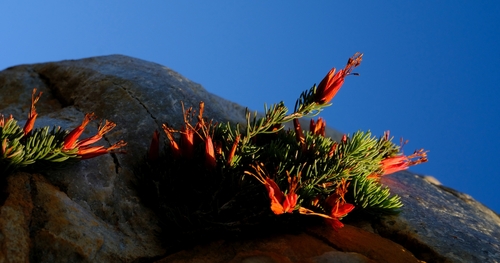
Royal Heath
Erica adelopetala
A rare crown jewel of the Cape Floristic Region, the Royal Heath dazzles with waxy crimson tubes designed for the beaks of sunbirds. This endangered fynbos specialist is a testament to the botanical wonder of South Africa's mountain slopes.
Quick Identification
Size
Height of 0.6–1.2 meters (2–4 feet) with a spread of approximately 0.5 meters (1.6 feet).
Colors
Waxy, tubular flowers in shades of deep pink to crimson; dark green needle-like foliage.
Key Features
- Long tubular flowers with small, inconspicuous petals
- Whorled, needle-like (ericoid) leaves
- Woody, upright shrub habit
- Endemic to the South African Overberg region
When You’ll See Them
Geographic range
Where Does the Royal Heath Live?
The Royal Heath is native to the African continent, found exclusively within a tiny geographical footprint in the Western Cape of South Africa. It is a highly localized endemic, primarily centered in the Kleinrivier Mountains near the town of Hermanus and extending toward Stanford. Because it is restricted to such a specific mountain range, it is considered a rare find even within its native country.
Basemap © OpenStreetMap contributors
Behavior
The Royal Heath is a resilient, woody shrub characteristic of the fynbos biome. Unlike many garden plants, it is highly adapted to nutrient-poor soils and a Mediterranean climate. It follows a 're-seeder' survival strategy, meaning the adult plants are typically killed by the periodic wildfires natural to its habitat, but the heat triggers the release or germination of seeds stored in the soil to start the next generation.
Ecologically, this species is a vital nectar source. It has evolved a symbiotic relationship with nectar-feeding birds, specifically sunbirds. The tubular shape of the flower is perfectly matched to the curved beaks of these birds. As the bird reaches deep into the flower for a nectar reward, it inadvertently collects pollen on its head, which it then transports to the next plant, ensuring the heath's genetic diversity.
EverydayEarth exclusive
Camera Tips
Capturing the Royal Heath on camera is less about movement and more about timing and the visitors it attracts. To get the best results, set up your camera on a tripod or stable mount during the peak flowering season from late winter to early summer. Use a macro lens or a close-up setting to capture the waxy texture and delicate structure of the tubular flowers, which are the plant's most striking feature.
Because the Royal Heath is a primary food source for the Southern Double-collared Sunbird and the Cape Sugarbird, the best way to utilize an AI-powered camera is to set it to 'Bird' trigger mode. Position the camera about 3 to 5 feet away from a healthy cluster of blooms, ensuring the background is slightly out of focus to make the vibrant pink flowers and the visiting birds pop. Early morning light (the 'Golden Hour') is ideal, as it highlights the nectar-filled tubes and the iridescent feathers of the visiting pollinators.
If you are monitoring growth or the health of a population, consider a time-lapse setting. A single frame taken every 6 hours over the course of the blooming season can provide a fascinating look at how the shrub responds to rain and sun. Ensure your camera is well-camouflaged if placed in a public hiking area, and always respect the fragile fynbos ecosystem by staying on marked paths while setting up your equipment.
Frequently Asked Questions
Record Royal Heath at your habitat
Connect a camera to start building your own species record — AI identifies every visitor automatically.