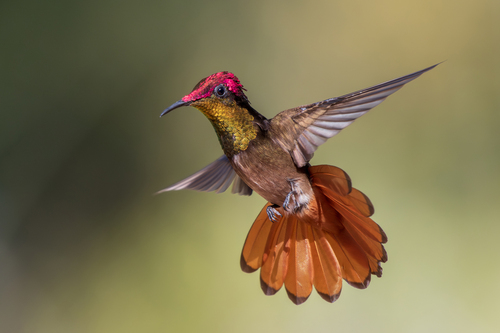
Ruby-topaz Hummingbird
Chrysolampis mosquitus
Witness the spectacular 'living gem' of the tropics. The Ruby-topaz Hummingbird dazzles observers with its fiery iridescence and bold, territorial personality.
Quick Identification
Size
Length: 8–9 cm (3.1–3.5 in); Weight: 3.5–5 g (0.12–0.18 oz)
Colors
Males have a brilliant ruby-red crown and nape with a golden-orange iridescent throat; females are bronze-green with pale grey underparts.
Key Features
- Iridescent ruby-red crown and golden-topaz throat on males
- Rufous tail with a dark terminal band
- Slightly decurved black bill
- Females often show a dark vertical streak on a pale throat
When You’ll See Them
Behavior
The Ruby-topaz Hummingbird is often described as a 'living jewel' due to the male's spectacular iridescence. These birds are highly territorial and surprisingly aggressive for their size, frequently chasing away larger hummingbirds or honeycreepers from their preferred nectar sources. They are active and fast flyers, moving with a characteristic darting motion between flowering shrubs.
While they are solitary like most hummingbirds, they are well-adapted to human-modified landscapes. In backyards and gardens, they are known for their 'trap-lining' behavior, where they follow a specific route of flowering plants throughout the day. They are particularly famous for their display posture, where the male tilts his head toward the sun to maximize the flash of his brilliant crown and throat feathers.
EverydayEarth exclusive
Camera Tips
Capturing the Ruby-topaz Hummingbird on an AI-powered camera requires a strategic focus on lighting. Because their 'ruby' and 'topaz' colors are structural (caused by light interference rather than pigment), they only appear at specific angles. Position your camera so it faces away from the morning or evening sun, allowing the direct light to hit the bird's chest and crown as it approaches your feeder or flowers. This 'front-lighting' is the only way to ensure the AI identifies the brilliant reds and golds rather than just a dark silhouette.
For the best results, mount your camera approximately 3 to 5 feet away from a concentrated nectar source. If you are using a feeder, choose one with a perch, as this encourages the bird to remain stationary for several seconds, giving your camera’s sensor time to lock focus and capture high-resolution frames. If you are planting for them, prioritize tubular flowers in shades of red, orange, or yellow, such as Ixora or Hibiscus, and place the camera at the height of the most active blooms.
Since these birds are incredibly fast, set your camera to the highest possible frame rate or 'burst mode.' If your device allows for shutter speed adjustments, aim for 1/2000th of a second or faster to freeze the wing motion. In the EverydayEarth app, look for 'Hummingbird Mode' settings which prioritize high-speed motion triggers. Seasonally, keep your camera active during the driest months when these birds are most likely to visit garden water features or feeders to supplement their natural diet.
Similar Species
Species that look similar or are commonly confused with Ruby-topaz Hummingbird.
Frequently Asked Questions
Record Ruby-topaz Hummingbird at your habitat
Connect a camera to start building your own species record — AI identifies every visitor automatically.