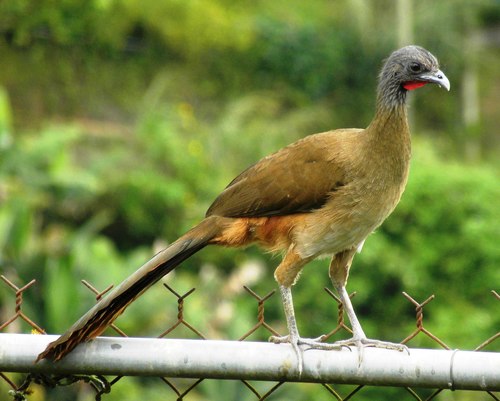
Rufous-vented Chachalaca
Ortalis ruficauda
The Rufous-vented Chachalaca is the charismatic, vocal soul of the Caribbean dry forest. Known for its raucous morning calls and social antics, this 'chicken of the trees' is a favorite for backyard birders and wildlife photographers alike.
Quick Identification
Size
Length of 53–58 cm (21–23 in); weight typically between 450–800 g (1–1.75 lbs)
Colors
Olive-brown upperparts and wings, grey head and neck, and a distinctive rufous (reddish-brown) belly and vent. The dark tail features prominent chestnut or rufous tips.
Key Features
- Long, dark tail with bright rufous tips
- Bare red skin patch on the throat
- Grey head contrasting with olive-brown body
- Social, chicken-like build with a small head and long neck
When You’ll See Them
Geographic range
Where Does the Rufous-vented Chachalaca Live?
This species is primarily native to the northern reaches of South America, with its core populations thriving across northern Venezuela and northeastern Colombia. It is a signature bird of the Caribbean coast, where it is found in both humid and semi-arid environments near the shoreline. Beyond the mainland, it is the national bird of Tobago and has been successfully introduced to several islands in the Grenadines, such as Bequia and Union Island, where it has established stable populations in the scrubby hillsides.
Basemap © OpenStreetMap contributors
Behavior
The Rufous-vented Chachalaca is a boisterous and highly social bird, best known for its deafening dawn chorus. These birds live in family groups or small flocks of up to 20 individuals, moving through the canopy and undergrowth with surprising agility. They are famous for their rhythmic, four-note call—often interpreted as 'cha-cha-la-ca' or 'gua-cha-ra-ca'—which they perform in raucous duets or group ensembles to defend their territory.
While they spend a significant amount of time in the trees foraging for food, they are frequently seen descending to the ground to hop across lawns or visit garden feeders. In areas like Tobago, they have become remarkably habituated to human presence, often appearing in suburban backyards where they are bold, inquisitive, and occasionally demanding of snacks. Despite their loud nature, they can be quite elusive when they feel threatened, melting into thick foliage with ease.
EverydayEarth exclusive
Camera Tips
To capture the Rufous-vented Chachalaca on camera, focus on transition zones between thick brush and open clearings. These birds love to forage on the ground near the base of fruit trees. Set your camera at a low height—about 1 to 2 feet off the ground—angled slightly upward to catch their impressive tail feathers and the red skin of their throat when they call. Since they move in groups, using 'Burst Mode' or 'Photo Series' is essential; you'll likely capture a lead bird followed by several others in a row.
Baiting is highly effective for this species if local regulations allow. A platform feeder or a simple cleared patch of ground stocked with overripe bananas, papaya chunks, or cracked corn will act like a magnet. Because they are most active during the low-light hours of early morning, ensure your camera has a high-quality sensor that can handle shadows without excessive grain. If you are using video, the 'Golden Hour' just before sunset provides the best lighting for their olive and chestnut plumage.
In a backyard setting, a reliable water source is a major draw. A large, ground-level bird bath or a shallow water feature will encourage them to linger for grooming and drinking. Place the camera facing the water source from a distance of 5-8 feet. Be sure to check your settings for a fast trigger speed, as they can be surprisingly quick when they decide to fly back into the safety of the canopy.
Similar Species
Species that look similar or are commonly confused with Rufous-vented Chachalaca.
Frequently Asked Questions
Record Rufous-vented Chachalaca at your habitat
Connect a camera to start building your own species record — AI identifies every visitor automatically.