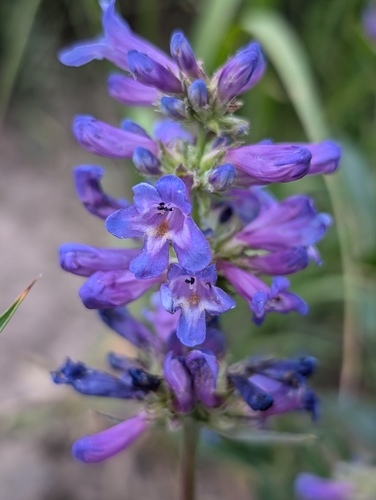
Rydberg's Beardtongue
Penstemon rydbergii
A signature beauty of the American West, Rydberg's Beardtongue stands tall in damp meadows with its striking stacks of indigo blooms. It is a vital oasis for high-altitude pollinators and a stunning subject for any nature photographer.
Quick Identification
Size
20-60 cm (8-24 inches) tall; flower tubes approximately 1-1.5 cm (0.4-0.6 inches) long
Colors
Vibrant indigo, violet, or sky blue flowers; deep green foliage; occasionally reddish-tinged stems
Key Features
- Distinct whorled flower clusters (verticillasters) stacked along the upper stem
- Smooth, lance-shaped leaves arranged in opposite pairs
- Tubular flowers with a prominent, often hairy sterile stamen (the 'beardtongue')
- Clump-forming growth habit suited for damp soils
When You’ll See Them
Behavior
Rydberg's Beardtongue is a perennial wildflower that defines the aesthetic of Western mountain meadows. Unlike many other Penstemon species that prefer well-drained, rocky slopes, this plant 'behaves' like a moisture-seeker, flourishing in damp grasslands and forest edges where snowmelt lingers. It grows in tidy, non-aggressive clumps, sending up several vertical flower spikes each summer that act as a high-value buffet for the local insect community.
This species plays a critical role in its ecosystem by timing its blooming cycle with the emergence of native bumblebees and long-tongued bees. The tubular shape of the flowers is a specific evolutionary 'behavior' designed to exclude smaller, less efficient pollinators while rewarding larger insects and hummingbirds that can reach the nectar at the base. While stationary, the plant exhibits 'movement' through its seasonal growth, starting as a low basal rosette of leaves in the spring before rapidly shooting upward as temperatures rise in May and June.
EverydayEarth exclusive
Camera Tips
To capture the best images of Rydberg's Beardtongue, you should treat the plant as the stage and the visiting pollinators as the actors. Position your AI-powered camera on a low-profile stake or tripod, approximately 12 to 20 inches from the ground. Angle the lens slightly upward to emphasize the 'stacked' appearance of the flower whorls against the background. For the best clarity, ensure the camera is placed on the side of the plant that receives direct morning light, as the deep blues and purples of the petals can appear muted or muddy in deep shade.
Because these flowers are popular with fast-moving targets like the broad-tailed hummingbird and various clearwing moths, set your camera to a 'high sensitivity' or 'fast motion' trigger mode. If your camera allows for custom shutter speeds, aim for at least 1/1000th of a second to freeze the wing motion of visitors. Since this species grows in damp meadows where wind is frequent, motion-blur can be a challenge. Using a physical stake to subtly stabilize the main stem—without damaging the plant—can help keep the flower in focus during breezy afternoons.
For those interested in the 'secret life' of the meadow, try a time-lapse setting. Rydberg's Beardtongue flowers open sequentially from the bottom of the stalk upward. A photo every 30 minutes over a period of three days can create a stunning visual of the blooming process. No lures or baits are needed for this species; its natural nectar production is the only bait you need. Simply ensure the area around the base of the plant is clear of tall grass that might obscure the lens or cause false triggers when the wind blows.
Frequently Asked Questions
Record Rydberg's Beardtongue at your habitat
Connect a camera to start building your own species record — AI identifies every visitor automatically.