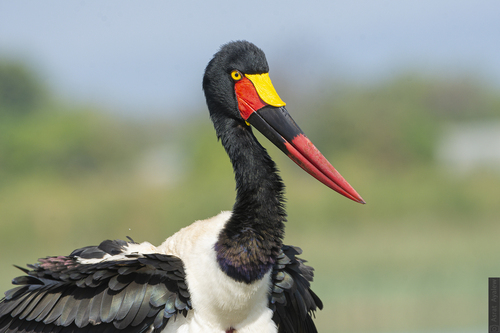
Saddle-billed Stork
Ephippiorhynchus senegalensis
Meet the most colorful giant of the African wetlands. With its massive 'saddled' bill and striking iridescent plumage, the Saddle-billed Stork is the ultimate prize for any backyard or trail camera enthusiast.
Quick Identification
Size
Height of 145–150 cm (57–59 in), wingspan of 240–270 cm (94–106 in), weighing 6–7 kg (13–15 lbs)
Colors
Bold black and white plumage with iridescent green/purple sheen on dark feathers; bill is bright red with a black central band and a yellow frontal shield (the 'saddle'); males have dark eyes, females have bright yellow eyes
Key Features
- Massive red and black bill with a yellow 'saddle' at the base
- Bright yellow irises in females vs. dark brown in males
- Extremely tall, leggy silhouette with red 'knees'
- Two small yellow wattles hanging from the base of the bill
When You’ll See Them
Sightings on EverydayEarth
May 18, 2026
Several Saddle-billed Storks are seen standing and preening on sandbanks in the middle of the river. The birds are spread across different exposed areas of sand, taking advantage of the low water levels to rest and forage in the morning sun.
Apr 10, 2026
A Saddle-billed Stork stands motionless on a grassy patch of land in the middle of the river, scanning the shallow water for potential prey. The flowing water of the Olifants River surrounds the bird's location.
Behavior
The Saddle-billed Stork is a master of patience and precision, often seen standing perfectly still in shallow waters as it waits for the perfect moment to strike. Unlike many other stork species that are highly social, Saddle-bills are remarkably territorial and solitary. They are typically found alone or in monogamous pairs, patrolling a specific stretch of river or wetland that they will defend vigorously against intruders.
These birds are known for their dignified gait and silent nature; they lack a vocal box (syrinx) and communicate primarily through bill-clattering, especially when at the nest. They are extremely sensitive to human disturbance and habitat loss, which makes them a rare and prestigious find for any trail camera enthusiast. Observing their pair-bonding displays, which involve synchronized bowing and wing-spreading, is a highlight of African avian behavior.
EverydayEarth exclusive
Camera Tips
Capturing the magnificent Saddle-billed Stork on camera requires a strategic approach focused on water access points. Because these birds are exceptionally tall—standing nearly five feet high—you should mount your camera approximately 3 to 4 feet off the ground. Angle the lens slightly upward if you are positioned close to the water’s edge, or keep it level if the camera is set back. This ensures you capture the full height of the bird, especially that iconic bill, rather than just its long, spindly legs. Position your device overlooking shallow pans, river sandbars, or floodplains where the water is no deeper than 18 inches, as this is their primary foraging ground.
Since these storks are visual hunters that move with slow, deliberate steps and often stand motionless for minutes at a time, set your camera's motion sensitivity to its highest level. This prevents the camera from 'missing' the bird during its statue-like hunting phases. Using a 'Burst Mode' or a 'Photo + Video' setting is highly recommended; the initial photo captures a high-resolution still portrait, while the subsequent video can catch the dramatic, lightning-fast moment they thrust their massive bill into the water to snatch a fish. Avoid using white-light flash at night as it can spook these wary birds, though they are primarily diurnal, so high-quality daylight settings are your best friend.
Timing and location are everything. They are most active in the golden hours of the early morning and late afternoon when light is best for photography. If you have a large property with a dam or permanent water hole, maintaining a quiet, human-free 'buffer zone' will encourage them to visit. They are incredibly sensitive to changes in their environment, so try to camouflage your camera using natural vegetation, bark, or a 'hollow log' housing to make the equipment look like part of the landscape. During the dry season, they become more predictable as they frequent the few remaining permanent water sources, making this the peak time for high-quality captures.
Similar Species
Species that look similar or are commonly confused with Saddle-billed Stork.
Frequently Asked Questions
Record Saddle-billed Stork at your habitat
Connect a camera to start building your own species record — AI identifies every visitor automatically.