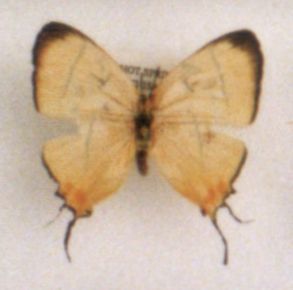
Saffron Sapphire
Iolaus pallene
With its brilliant golden wings and hidden metallic 'sapphire' spots, the Saffron Sapphire is a high-speed jewel of the African savanna. Discover how to spot this elusive mistletoe-lover in your own backyard.
Quick Identification
Size
Wingspan 30–42 mm (1.2–1.65 inches); males are typically smaller than females.
Colors
Brilliant saffron-yellow upperside with narrow black borders. The underside is creamy-white with thin, wavy orange-red lines and distinctive metallic blue and black 'sapphire' spots near the hindwing tails.
Key Features
- Bright saffron-yellow wing uppersides
- Metallic blue spots on the hindwing underside
- Thin, delicate tails on the hindwings
- Rapid and erratic flight pattern
- Black margins on the forewing tips
When You’ll See Them
Behavior
The Saffron Sapphire is a spirited and fast-flying member of the Lycaenidae family. Unlike the slow, bobbing flight of many garden butterflies, this species moves with incredible speed and precision. Males are highly territorial and are famous for 'hilltopping,' a behavior where they congregate on the highest points of shrubs or small ridges to defend their space and wait for females to pass by.
These butterflies are closely tied to the canopy of trees, specifically those hosting parasitic mistletoes. They spend a significant amount of time high above the ground, though they will descend to lower levels to feed on nectar or when females are searching for suitable spots to lay eggs. Despite their small size, their brilliant yellow color makes them surprisingly easy to spot when they catch the sunlight mid-flight.
EverydayEarth exclusive
Camera Tips
Capturing the Saffron Sapphire requires a strategic approach because they spend so much time in the upper canopy. To bring them within range of your camera, identify trees in your area that are heavily infested with mistletoe. Position your camera at a height of 5 to 7 feet, aiming at flowering branches of the host tree or nearby nectar sources like Cape Honeysuckle or Plumbago. A side-on angle is best to capture the contrast between the yellow upperside and the intricate 'sapphire' markings on the underside.
Because these butterflies are exceptionally fast, standard trail camera triggers may result in 'ghost' images or empty frames. If your camera setup allows for manual adjustments, use a fast shutter speed (1/1000s or higher) and set your motion sensitivity to the highest level. If you are using an AI-powered backyard camera, try to place it near a 'perching twig'—a bare, sunny branch that stands out from the rest of the foliage. Males often return to the exact same perch repeatedly after chasing off intruders, giving you multiple chances for a clear shot.
A professional secret for attracting Saffron Sapphires to ground level is 'mud-puddling.' Create a small patch of damp, sandy soil in a sunny spot and add a tiny pinch of sea salt or organic compost. Butterflies often land on these patches to drink mineral-rich water. Setting your camera on a low tripod or ground mount facing a mud-puddle patch during the hottest part of the day (11 AM to 2 PM) is one of the most reliable ways to get high-resolution, still images of this species without the interference of wind-blown branches.
Frequently Asked Questions
Record Saffron Sapphire at your habitat
Connect a camera to start building your own species record — AI identifies every visitor automatically.