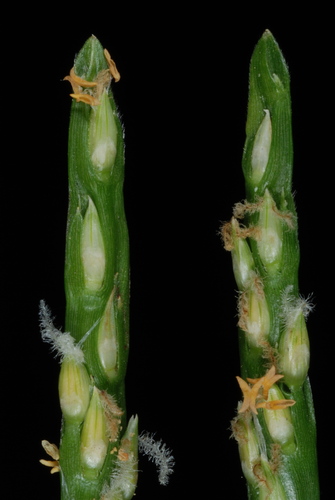
Saint Augustine grass
Stenotaphrum secundatum
The thick, emerald carpet of the coastal South, Saint Augustine grass is a hardy survivor that thrives where other grasses fade. Known for its broad, blunt-tipped blades and vigorous creeping stolons, it creates a lush micro-ecosystem right in your backyard.
Quick Identification
Size
Maintains a height of 2-12 inches (5-30 cm) depending on mowing; stolons (runners) can extend 3-5 feet (0.9-1.5 m) across the ground.
Colors
Deep emerald to blue-green blades; stolons often exhibit a reddish-purple or brownish tint at the nodes.
Key Features
- Wide, coarse leaf blades with distinctly rounded, boat-shaped tips
- Flattened, compressed stems (stolons) that creep along the soil surface
- Opposite leaf arrangement along the runners
- Forms a dense, carpet-like sod that feels spongy underfoot
When You’ll See Them
Behavior
Saint Augustine grass is a resilient, warm-season perennial that spreads primarily through vigorous above-ground runners called stolons. Unlike many other grasses that use underground rhizomes, this species 'crawls' across the surface, rooting at various nodes to claim new territory. This aggressive growth pattern allows it to form a dense, thick mat that naturally chokes out most competing weeds and other grass varieties, creating a uniform green blanket.
In the backyard ecosystem, Saint Augustine grass acts as a vital foundation for local biodiversity. Its thick sod provides a humid, protected microhabitat for beneficial insects, spiders, and small amphibians like toads. While it is highly prized by humans for its salt tolerance and ability to thrive in shaded areas where other grasses fail, it is also a rugged survivor that can withstand heavy foot traffic and coastal conditions.
EverydayEarth exclusive
Camera Tips
Capturing the beauty of Saint Augustine grass requires a shift in perspective. To document its growth and the wildlife it hosts, place your AI-powered camera at 'bug-eye level.' Secure the camera on a low-profile stake or a flat stone no more than 2-4 inches off the ground. Angle the lens slightly upward to catch the light filtering through the broad blades, which reveals the intricate parallel venation characteristic of this species. This low angle is also perfect for spotting small creatures like green anoles or wolf spiders that use the grass as a hunting ground.
Time-lapse is the secret weapon for Saint Augustine grass. Set your camera to take a photo every hour during the peak growing season (May to August). Over a week, you will see the 'behavior' of the grass as the stolons visibly creep forward and the blades tilt to follow the sun's path. If your camera has a macro setting, use it to capture the morning dew clinging to the rounded tips of the blades; the AI will often pick up the tiny insects that come to drink from these droplets.
For the best lighting, aim for the 'golden hours'—shortly after sunrise or just before sunset. The low-angle sunlight catches the coarse texture of the blades and highlights the vibrant green hue. Avoid mid-day sun, which can wash out the colors and create harsh shadows within the thick sod. If you are monitoring lawn health, look for the 'v-shape' in the blades during dry spells, which is a sign the grass is conserving moisture and may need a drink.
Similar Species
Species that look similar or are commonly confused with Saint Augustine grass.
Centipede Grass
Centipede grass has much narrower blades and a lighter, lime-green color compared to the coarse, dark green Saint Augustine.
Bermuda Grass
Bermuda grass has very fine, pointed blades and produces seed heads that look like a small bird's foot, whereas Saint Augustine has broad, blunt blades.
Frequently Asked Questions
Record Saint Augustine grass at your habitat
Connect a camera to start building your own species record — AI identifies every visitor automatically.