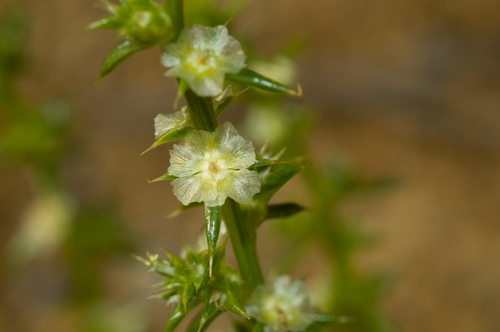
saltwort
Salsola kali
A resilient survivor of the coastline, prickly saltwort turns harsh salt spray and shifting sands into a home. Known for its prickly armor and its late-season role as a coastal tumbleweed, it is a master of dispersal and desert-like endurance.
Quick Identification
Size
10-60 cm (4-24 inches) tall; can spread up to 1 meter (39 inches) in diameter
Colors
Grey-green to bluish leaves; stems often feature reddish or purple stripes; small, translucent greenish flowers with pinkish tints
Key Features
- Fleshy, succulent leaves ending in a sharp, prickly spine
- Dense, bushy branching pattern forming a rounded shape
- Small, inconspicuous flowers tucked into leaf axils
- Tumbleweed behavior once the plant dries and detaches at the base
When You’ll See Them
Behavior
Prickly saltwort is a hardy annual that thrives where few other plants can survive. As a pioneer species, it is often the first to take root in the shifting sands of coastal dunes and salty shorelines. During the spring and summer, it grows rapidly, utilizing specialized salt-tolerant cells to manage the harsh coastal environment. Its succulent leaves store water, allowing it to withstand the drying effects of wind and salt spray.
The most fascinating aspect of saltwort behavior occurs at the end of its life cycle. Once the plant has set its seeds and died back in the autumn, the base of the stem becomes brittle and eventually snaps. This turns the entire plant into a 'tumbleweed,' which rolls across the beach or dunes with the wind. This movement is a clever survival strategy, as it allows the plant to broadcast its seeds over a wide area while it travels.
EverydayEarth exclusive
Camera Tips
Capturing the life of prickly saltwort requires a different approach than filming wildlife. Because it is a plant, time-lapse photography is your best friend. Set your camera on a sturdy tripod or a ground stake very low to the sand—about 6 to 12 inches high. This low angle emphasizes the plant's structural, prickly texture against the horizon. For growth sequences, set the camera to take one photo every hour during daylight hours over the course of the summer.
To capture the iconic 'tumbleweed' action, you will need to utilize your camera's motion sensors during high-wind events in late autumn. Position your camera along a natural 'drift' area on a beach where debris accumulates. Use a high shutter speed (at least 1/1000s) to freeze the motion of the saltwort as it rolls past. Avoid using bait, as this is a plant, but look for areas with high concentrations of dried saltwort 'skeletons' to increase your chances of a successful shot.
The lighting in coastal environments can be harsh. The best footage is often captured during the 'golden hour'—shortly after sunrise or before sunset. The low sun highlights the translucent edges of the flowers and the sharp spines. If you are using an AI-powered camera like those from EverydayEarth, ensure the lens is protected from salt spray and sand abrasion by using a clear filter or a protective housing, as these coastal elements can be highly corrosive over time.
Frequently Asked Questions
Record saltwort at your habitat
Connect a camera to start building your own species record — AI identifies every visitor automatically.