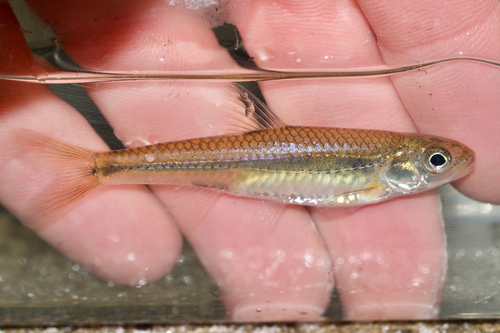
Sand Shiner
Miniellus stramineus
The Sand Shiner is a shimmering, social minnow that brings life to the sandy shallows of North American streams. Often seen in glittering schools, these hardy little fish are masters of the riverbed, spending their days darting through clear currents.
Quick Identification
Size
2 to 3.2 inches (5 to 8 cm) in length; weight is typically less than 0.1 ounces (3 grams)
Colors
Silvery-white sides with a translucent, straw-colored or tan back; dark midline stripe and subtle diamond-shaped outlines on the scales
Key Features
- Distinct dark wedge-shaped spot at the base of the tail fin
- Small, slightly subterminal mouth positioned for bottom feeding
- Translucent body with a straw-colored tint along the spine
- Dark 'X' or 'V' shaped markings along the lateral line
When You’ll See Them
Behavior
Sand Shiners are highly social, schooling fish that spend the majority of their lives hovering just above the sandy or gravelly beds of clear streams and rivers. They are exceptionally active during the day, moving in coordinated groups that can range from a dozen to several hundred individuals. This schooling behavior serves as their primary defense against larger predators like bass and herons, as the collective glimmer of their silvery scales can confuse an attacker.
While they are relatively shy, Sand Shiners are curious about changes in their environment. If a human stands still in the water, these fish will often approach to investigate, sometimes even nipping at toes or legs in search of loose skin or small parasites. They spend much of their time 'tasting' the substrate, dipping their heads down to sift through sand for microscopic morsels, a behavior that keeps them constantly on the move throughout the sunlit hours.
EverydayEarth exclusive
Camera Tips
Capturing the Sand Shiner requires an underwater action camera or a specialized submersible trail camera. To get the best results, place your camera in shallow, moving water (roughly 6 to 12 inches deep) where the bottom is visibly sandy. Position the lens parallel to the stream bed or at a very slight downward angle to capture the fish as they forage. Using a small weighted tripod or a flat 'bean bag' mount will keep the camera stable against the current.
While they aren't attracted to traditional 'bait' in the same way mammals are, you can trigger a feeding frenzy by disturbing the sand just upstream of your camera. This releases buried insect larvae and organic matter into the current, drawing the school directly into your frame. For the most natural look, avoid artificial lights; instead, time your recording for midday when the sun is directly overhead, as this illuminates their translucent bodies and the golden 'straw' hue of their backs beautifully.
Because these fish move rapidly, use a high frame rate setting—at least 60 frames per second (fps). This allows you to slow down the footage in post-production to see their intricate mouth movements and social interactions. If your camera has a 'wide-angle' setting, use it; Sand Shiners often move in wide arcs, and a narrow field of view might miss the sheer scale of the school as it passes by. Ensure your waterproof housing is clean and free of fingerprints, as the clear water they inhabit will show every smudge.
Similar Species
Species that look similar or are commonly confused with Sand Shiner.
Mimic Shiner
The Mimic Shiner lacks the distinct wedge-shaped spot at the tail base and typically has more elevated scales on its sides.
Bigeye Shiner
Features significantly larger eyes relative to its head size and a darker, more prominent lateral stripe.
Emerald Shiner
Has a more elongated, iridescent green body and prefers the open waters of larger lakes and rivers rather than sandy stream beds.
Frequently Asked Questions
Record Sand Shiner at your habitat
Connect a camera to start building your own species record — AI identifies every visitor automatically.