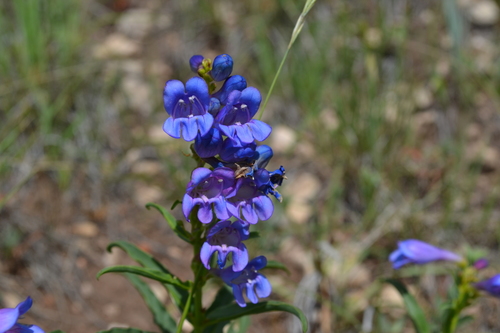
Sawsepal Beardtongue
Penstemon glaber
The Sawsepal Beardtongue is an electric-blue masterpiece of the American West. A favorite of hummingbirds and bumblebees, this hardy perennial transforms any backyard into a bustling pollinator sanctuary.
Quick Identification
Size
Grows 12–24 inches (30–60 cm) tall with flower clusters spanning 6–10 inches
Colors
Brilliant sky-blue to deep violet flowers with smooth, waxy green foliage
Key Features
- Tubular blue flowers with five flared lobes
- Smooth, hairless stems and leaves (glabrous)
- Sepals with jagged, saw-like edges
- One sterile, fuzzy-tipped stamen known as the 'beard'
When You’ll See Them
Behavior
Sawsepal Beardtongue is a perennial wildflower that serves as a cornerstone for pollinator activity in the western landscape. Unlike some garden varieties that have been bred for size over substance, this native species produces high-quality nectar that attracts a specific suite of local wildlife. It doesn't 'behave' in the animal sense, but it does follow a rhythmic cycle of opening its blooms in the early morning to maximize visitation from bees when the air is still cool.
As a social hub, this plant is frequently visited by long-tongued bees, such as bumblebees and mason bees, who are strong enough to push past the flower's 'lips.' In the backyard ecosystem, Sawsepal Beardtongue is a reliable neighbor, requiring very little maintenance once established and providing a steady source of visual beauty and ecological support from late spring through mid-summer.
EverydayEarth exclusive
Camera Tips
To capture the best images of Sawsepal Beardtongue and its visitors, mount your camera on a low-profile stake or a small tripod, positioning the lens roughly 12 to 15 inches from the ground. Angle the camera slightly upward to look into the 'mouths' of the tubular flowers. This 'insect-eye view' is essential for seeing the intricate details of the saw-toothed sepals and the fuzzy stamen inside, which are the plant's namesake features.
Since the primary goal is capturing the pollinators that visit this plant, use a camera with a fast trigger speed. Set your AI camera to detect 'small animals' or 'insects' if those modes are available. Because the flowers are often a vibrant, reflective blue, they can occasionally 'blow out' or lose detail in harsh midday sun. To combat this, try to position your camera so the flowers are backlit during the golden hours of morning or late afternoon, which will make the blue petals appear to glow and highlight the fine hairs on visiting bees.
If you are using a motion-triggered trail camera, increase the sensitivity to its highest setting. The subtle movement of a hummingbird or a clearwing moth might not trigger a standard sensor, so high sensitivity is key. Additionally, set your camera to take a short 5-10 second video clip followed by a high-resolution photo; this allows you to see the pollinator's behavior as it interacts with the bloom. Avoid placing the camera too close to the ground in areas with heavy foot traffic, as the Sawsepal Beardtongue’s stalks are somewhat brittle and can be knocked over easily.
Lastly, consider the background. To make your Sawsepal Beardtongue photos look professional, ensure there is several feet of clear space behind the plant. This creates a natural 'bokeh' effect where the flowers are in sharp focus while the background is a soft, green blur, making the electric-blue petals truly pop in your gallery.
Frequently Asked Questions
Record Sawsepal Beardtongue at your habitat
Connect a camera to start building your own species record — AI identifies every visitor automatically.