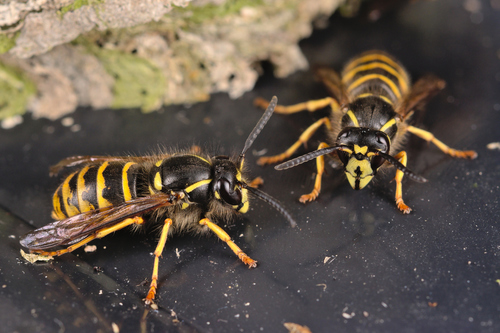
Saxon Wasp
Dolichovespula saxonica
A sophisticated aerial architect, the Saxon Wasp is a gardener's friend that builds intricate paper nests and provides natural pest control. More docile than its cousins, this striking yellow-and-black insect is a fascinating subject for any backyard observer.
Quick Identification
Size
Body length 11–18 mm (0.43–0.71 in); wingspan 25–35 mm (0.98–1.38 in)
Colors
Bright yellow and black banding; yellow face usually features a single vertical black bar or small spot
Key Features
- Aerial paper nests built in trees or eaves
- Short-faced anatomy with small gap between eye and jaw
- Vertical black line on the clypeus (face)
- Thorax features yellow stripes on a black base
When You’ll See Them
Behavior
Saxon Wasps are highly social insects that live in colonies organized by a queen, workers, and drones. Known as one of the more 'gentle' wasp species, they are significantly less aggressive toward humans than the Common or German wasp, typically only stinging if their nest is physically disturbed. They are master architects, chewing wood fibers into a pulp to create beautiful, grey, globe-shaped paper nests that hang from branches or man-made structures.
Unlike many other social wasps that stay active well into the autumn, the Saxon Wasp has a relatively short lifecycle. The colony reaches its peak in mid-summer and often begins to decline by August. They are highly efficient communicators, using a complex system of chemical signals and pheromones to alert the colony to food sources or potential threats near their aerial home.
EverydayEarth exclusive
Camera Tips
To capture the best footage of Saxon Wasps, you should focus your efforts on their unique nesting habits. Look for their distinctive grey, paper-like spheres hanging under the eaves of garden sheds, porches, or within dense shrubbery. When placing your camera near a nest, use a tripod and maintain a distance of at least 3 to 5 feet. This ensures you won't disturb the colony while allowing you to capture the 'flight path' as workers enter and exit the bottom of the nest. If your camera has a macro lens or a close-focusing accessory, this is the perfect time to use it to reveal the intricate wood-swirl patterns on the nest's exterior.
Luring Saxon Wasps to a specific spot for a clear photo is easily done with a 'wasp bar.' Place a shallow dish of sugar water or a piece of overripe fruit—peaches and plums work exceptionally well—in a bright, sunny patch of your yard. Position your camera at a 45-degree angle to the bait to capture both the side profile and the facial markings of the wasp as it feeds. Because these insects move with incredible speed, set your camera to its fastest shutter speed or use a high-frame-rate video setting (60fps or higher) to avoid motion blur and potentially capture the mechanics of their wing beats.
Don't overlook the importance of lighting and seasonality. Saxon Wasps are most active during the warmest, brightest parts of the day, so avoid placing your camera in deep shade where the shutter speed might drop. Since their season is shorter than other wasps, plan your camera sessions for June and July. If your camera supports time-lapse mode, try setting it up near a developing nest early in the season to record the fascinating way these insects expand their paper empire layer by layer over several weeks.
Similar Species
Species that look similar or are commonly confused with Saxon Wasp.
Frequently Asked Questions
Record Saxon Wasp at your habitat
Connect a camera to start building your own species record — AI identifies every visitor automatically.