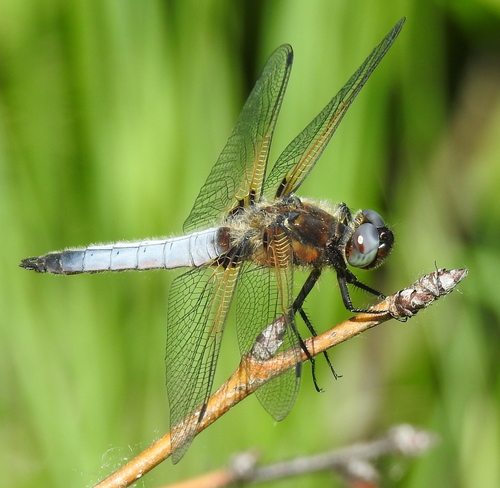
Scarce Chaser
Libellula fulva
A rare gem of the wetlands, the Scarce Chaser dazzles with its striking transition from vibrant orange to sky blue. Watch these master aerialists defend their sunny perches with incredible speed and precision.
Quick Identification
Size
Body length of 42-45 mm (1.6-1.8 inches) with a wingspan averaging 74 mm (2.9 inches)
Colors
Mature males feature a powder-blue abdomen with a distinct black tip; females and juveniles are a vibrant, fiery orange with a black line down the center of the abdomen.
Key Features
- Distinctive dark triangular patches at the base of the hindwings
- Mature males have a 'dusty' blue abdomen with black terminal segments
- Females possess a bright orange abdomen with a black dorsal stripe
- Dark smoky patches often visible at the wing tips
When You’ll See Them
Behavior
The Scarce Chaser is a territorial and highly observant dragonfly often found perched on emergent vegetation near slow-moving water. Unlike some dragonflies that spend hours on the wing, this species prefers a 'sit-and-wait' strategy. Males choose prominent perches—such as tall reeds or overhanging twigs—from which they defend their territory against rivals and dart out to intercept passing prey or potential mates.
When they aren't hunting, they spend significant time basking in the sun to regulate their body temperature. They are remarkably fast flyers but usually return to the same handful of favorite perches throughout the day. While they can be wary of sudden movements, they are generally approachable if you move slowly, making them a favorite subject for backyard naturalists with a patient eye.
EverydayEarth exclusive
Camera Tips
To capture high-quality footage of the Scarce Chaser, the secret lies in identifying their 'habitual perches.' These dragonflies are creatures of habit; if you see one landing on a specific reed or twig, it will likely return to that exact spot dozens of times. Position your AI camera on a tripod roughly 1 to 2 feet away from these perching spots. Because dragonflies are small, you will need a camera with a good macro focus capability or a close-up lens attachment to fill the frame.
Lighting is your best friend when filming the Scarce Chaser. Aim to have the sun behind your camera or at a slight side angle (45 degrees) to highlight the 'pruinescence'—the dusty blue wax—on the male's abdomen. This waxy coating can reflect light beautifully but can also 'blow out' in harsh direct midday sun, so early afternoon light is often the most flattering for capturing their intricate wing venation and color depth.
If your backyard doesn't have a natural perch near the water's edge, you can create a 'camera lure.' Simply push a bamboo cane or a slender, attractive branch into the mud near the water so that it stands taller than the surrounding grass. The Scarce Chaser will often choose the highest available vantage point, making this artificial perch the perfect stage for your camera. Set your camera's trigger speed to its fastest setting, as their take-offs and landings are lightning-fast.
For those using motion-activated cameras, ensure the sensitivity is set to high, as the small mass of a dragonfly might not always trigger standard PIR sensors. If your camera allows for 'Time Lapse' mode with short intervals (every 5-10 seconds), this is often a more reliable way to ensure you catch them during their long periods of sun-basking on their favorite reed.
Similar Species
Species that look similar or are commonly confused with Scarce Chaser.
Frequently Asked Questions
Record Scarce Chaser at your habitat
Connect a camera to start building your own species record — AI identifies every visitor automatically.