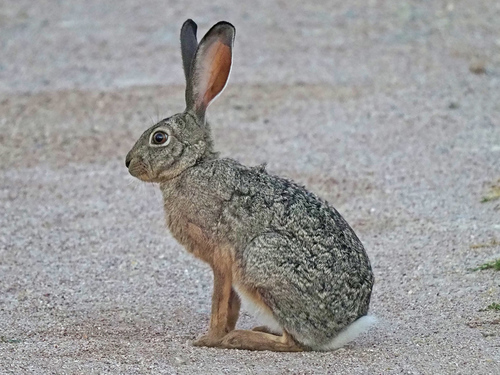
Scrub Hare
Lepus saxatilis
With their oversized ears and incredible speed, the Scrub Hare is a charismatic nocturnal visitor to many Southern African gardens. This master of disguise remains hidden all day, only emerging under the cover of darkness to roam our backyards.
Quick Identification
Size
18-26 inches (45-65 cm) in length; weighing 3.3-9.9 lbs (1.5-4.5 kg)
Colors
Grizzled grey-brown upper parts with a salt-and-pepper appearance; clear white underparts and a white tail with a black top.
Key Features
- Exceptionally long, black-tipped ears
- White underside and tail with a black top
- Reddish or tawny patch on the nape of the neck
- Lanky, long-legged build adapted for high-speed running
When You’ll See Them
Sightings on EverydayEarth
Jun 26, 2026
Under the cover of night, two scrub hares are active in a clearing. The hare on the right is focused on grooming its fur and legs, while the individual on the left remains stationary in a crouched, alert position, occasionally turning its head to scan for predators.
Jun 25, 2026
Two Scrub Hares are seen resting in an open sandy area during the night. The hare on the right is alert, sitting upright and moving its head and long ears to scan the environment, while the second hare remains tucked and stationary on the ground to the left.
Jun 24, 2026
Two Scrub Hares are resting in a dark clearing. The hare in the foreground remains still but alert, its large ears and white throat patch highlighted by the infrared light, while a second hare is visible further back in the scene.
Jun 23, 2026
Under the cover of night, a large White Rhinoceros is resting on the ground on the right side of the clearing. In the center of the scene, two Scrub Hares are visible sitting together; they remain mostly still but can be seen twitching their ears and looking around as they stay alert while foraging or resting.
Jun 21, 2026
In the background near the fence, a Scrub Hare sits alert in the grass. It remains mostly stationary but can be seen turning its head and twitching its ears, with its eye shine clearly visible against the dark woodland backdrop.
Jun 20, 2026
A Scrub Hare sits motionless in an open, dusty area under the cover of night. It remains alert, with its large ears held back against its body, occasionally shifting its head to scan the surroundings.
Behavior
The Scrub Hare is a master of camouflage, often spending its daylight hours hunkered down in a "form"—a shallow depression in the ground hidden under tall grass or thick shrubs. While they are mostly solitary, you might spot them in pairs during the breeding season or in small groups where food is particularly abundant. Unlike rabbits that disappear into burrows, these hares rely on their incredible speed and zigzagging running style to outmaneuver predators like caracals, jackals, and eagles.
In suburban settings, they are surprisingly adaptable and can become quite bold at night, venturing into gardens to nibble on lawns and flowerbeds. They are generally shy and will "freeze" if they sense a threat, hoping their mottled fur blends into the shadows. If you approach too closely, they explode into action with a powerful burst of speed, often startling the observer.
EverydayEarth exclusive
Camera Tips
To capture the best footage of a Scrub Hare, place your camera low to the ground—ideally just 6 to 12 inches high. This "hare-eye view" provides a more intimate perspective and ensures the camera's motion sensor isn't overshooting their relatively low profile. Look for "runs" or small flattened paths through the grass where they frequently travel between their daytime hiding spots and nighttime feeding grounds.
Since Scrub Hares are almost exclusively active after dark, camera performance in low light is crucial. Set your camera to a high-sensitivity PIR (Passive Infrared) mode to catch their quick movements. Using a "Fast Trigger" speed is essential because these animals can move very rapidly; if your trigger is too slow, you might only capture a blurry tail leaving the frame. If your camera allows for it, a short video clip of 10-15 seconds is often better than a still photo, as it captures their twitching whiskers and cautious grooming behaviors.
While we don't recommend artificial feeding, a fresh water source or a birdbath placed near the ground can be a powerful magnet during the dry winter months. Position the camera to face the water source from about 6-8 feet away. If you are in a particularly dry area, the lure of a reliable drink will bring them back to the same spot night after night, allowing you to study their individual markings.
Lastly, pay attention to the background. Scrub Hares have excellent camouflage, so try to angle your camera toward an area with a slightly lighter background, such as a sandy patch or a pale wall, to help their silhouette pop in night-vision mode. Check your SD cards frequently during the rainy season, as the growth of fresh green grass often triggers a significant spike in local hare activity!
Similar Species
Species that look similar or are commonly confused with Scrub Hare.
Frequently Asked Questions
Record Scrub Hare at your habitat
Connect a camera to start building your own species record — AI identifies every visitor automatically.