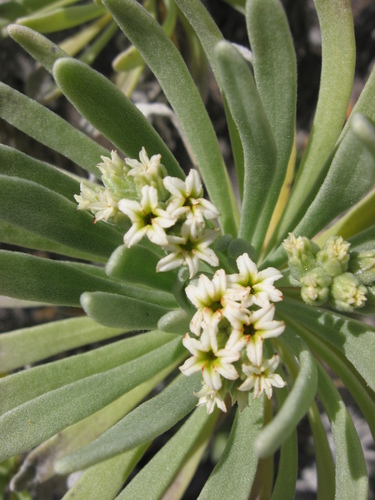
sea lavender
Tournefortia gnaphalodes
A resilient guardian of the shoreline, sea lavender shimmers with silvery-gray foliage and delicate white blooms. This salt-tolerant shrub is the backbone of the coastal garden, providing essential nectar for butterflies and a sturdy anchor for shifting sands.
Quick Identification
Size
A mounded shrub typically reaching 3 to 6 feet (0.9 to 1.8 m) in height with a similar spread.
Colors
Silvery-gray to sage-green foliage with small, bell-shaped white to pale lavender flowers.
Key Features
- Fleshy, succulent leaves covered in fine silver hairs
- Clusters of small white flowers at the ends of branches
- Dense, mounded growth habit
- Found primarily on sandy beach dunes
When You’ll See Them
Behavior
Sea lavender is a hardy pioneer species that plays a vital role in coastal ecosystems. It is exceptionally well-adapted to the "salt spray zone," where few other plants can survive. Its leaves are covered in dense, silky hairs that act as a protective barrier, reflecting intense UV rays and trapping moisture to help the plant survive in nutrient-poor, sandy soil and high-wind environments.
While it is a slow-growing evergreen, it serves as a critical anchor for sand dunes, helping to stabilize the shoreline against erosion during tropical storms. In a backyard or coastal garden, it acts as a social hub for local wildlife, providing sheltered nesting spots for small lizards and a reliable nectar source for various coastal pollinators, including several rare butterfly species.
EverydayEarth exclusive
Camera Tips
To capture the best images of sea lavender and the wildlife it attracts, mount your camera at a low height of about 1 to 2 feet. This "lizard-eye view" allows you to see into the dense, mounded structure of the plant where beach mice or anoles might be hiding. Because the foliage is highly reflective and silvery, try to angle your camera to avoid direct midday sun, which can cause significant glare and wash out the details of the succulent leaves.
If you are looking to document pollinators, place your camera approximately 2 to 3 feet from a fresh cluster of blooms. Sea lavender flowers are small, so using a camera with a macro lens or a close-focusing feature is ideal. Set your camera to a fast trigger speed or high-frame-rate video mode, as the butterflies and bees that frequent these flowers move rapidly between clusters. The best time for this is between 9 AM and 11 AM when the sun is bright enough to activate insects but not yet at its harshest peak.
For those monitoring coastal erosion or plant growth, sea lavender is an excellent subject for a long-term time-lapse. However, the coastal environment is brutal on electronics. Ensure your camera is housed in a high-quality, weather-sealed casing to protect it from the corrosive salt air. Periodically wipe the lens with a microfiber cloth to remove salt crust that can build up, even over just a few days of coastal monitoring.
In many regions, sea lavender is a protected or endangered species in the wild. If you are setting up a camera near a dune, ensure you are not trampling the root system or the dune itself. Use a weighted tripod or a sand-anchor mount rather than driving stakes deep into the sensitive dune soil, which could disturb the very plant you are trying to observe.
Frequently Asked Questions
Record sea lavender at your habitat
Connect a camera to start building your own species record — AI identifies every visitor automatically.