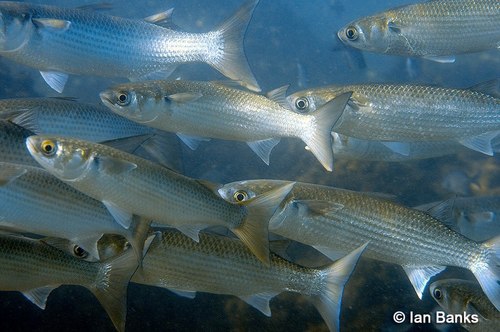
Sea Mullet
Mugil cephalus
Meet the silver acrobat of the shallows. The Sea Mullet is a world-traveling marvel known for its shimmering schools and spectacular leaps from the water.
Quick Identification
Size
30-75 cm (12-30 inches) in length; weighs 1-4 kg (2.2-8.8 lbs)
Colors
Olive-green to bluish-grey on the back, fading to silvery sides and a white belly; 6-7 dark horizontal stripes run along the scales
Key Features
- Distinctive dark longitudinal stripes along the scale rows
- Broad, flattened head with a blunt snout
- Prominent fatty 'adipose' eyelid covering most of the eye
- Two widely separated dorsal fins, the first with 4 stiff spines
When You’ll See Them
Geographic range
Where Does the Sea Mullet Live?
The Sea Mullet is a truly cosmopolitan species, inhabiting the temperate, subtropical, and tropical coastal waters of nearly every continent. In the Western Hemisphere, they are found from Nova Scotia down to Brazil in the Atlantic, and from California to central Chile in the Pacific. They are equally prevalent throughout the Mediterranean Sea, the coastlines of Africa, and the vast Indo-Pacific region, making them one of the most widely distributed fish species in the world.
Basemap © OpenStreetMap contributors
Behavior
Sea Mullet are highly social and energetic fish, almost always found traveling in large, synchronized schools. They are best known for their remarkable aerial displays, frequently leaping several feet out of the water. While scientists suggest this jumping helps them clear their gills of sediment or shake off parasites, it is a hallmark behavior that makes them easy to spot in shallow coastal waters.
These fish are peaceful bottom-feeders that play a vital role in the ecosystem. By consuming detritus and algae, they clean the seafloor and convert low-level nutrients into energy for larger predators. In backyard canal settings, they are often seen congregating around docks and seawalls, where they graze on the 'green fuzz' of algae growing on submerged structures. Despite their abundance, they are shy and will quickly scatter if they detect sudden movement from above.
EverydayEarth exclusive
Camera Tips
To capture Sea Mullet with an AI-powered camera, an underwater housing is essential. If you live on a coastal canal or tidal creek, mount your camera roughly 1-2 feet below the low-tide line on a dock piling or seawall. Aim the lens toward an area with visible algae growth or a sandy patch on the bottom. Because mullet move in schools, a wide-angle lens is preferred to capture the full scope of their social behavior rather than just a single passing fish.
Attracting Sea Mullet to your 'underwater backyard' is different than attracting birds or mammals. Since they are detritivores, traditional fishing bait doesn't work well. However, they are highly attracted to 'chum' made from oatmeal, wet bread, or specialized fish meal pellets. Placing a small mesh bag of this bait near your camera lens will create a feeding frenzy, providing excellent opportunities for high-quality footage. For the best clarity, set your camera to record during the two hours surrounding high tide, when the water is typically clearest and carries less sediment.
If you want to capture their famous jumping behavior, position a trail camera above the water on a tripod at the edge of a marsh or canal. Angle the camera slightly upward to catch the splash and the silver flash of their bodies in mid-air. Use a high-speed burst mode or high-frame-rate video setting (at least 60fps) to avoid motion blur. Early morning or late afternoon light is ideal, as it catches the reflective scales of the fish against the darker water, making it much easier for AI software to identify the movement as a jumping mullet.
Similar Species
Species that look similar or are commonly confused with Sea Mullet.
Frequently Asked Questions
Record Sea Mullet at your habitat
Connect a camera to start building your own species record — AI identifies every visitor automatically.