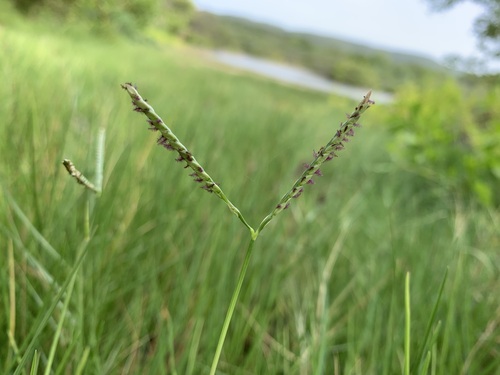
seashore paspalum
Paspalum vaginatum
The ultimate coastal survivor, seashore paspalum is a salt-loving grass that turns harsh, brackish shorelines into lush, emerald carpets. Whether stabilizing a wild dune or gracing a world-class golf course, its resilient runners and striking V-shaped seed heads are a testament to botanical endurance.
Quick Identification
Size
Typical height of 4 to 20 inches (10 to 50 cm); spreads indefinitely via runners
Colors
Bright lime green to deep emerald green; seed heads are often pale green to tan
Key Features
- Distinct V-shaped seed head with two slender branches
- Smooth, waxy leaf blades that feel soft to the touch
- Extensive network of above-ground stolons and below-ground rhizomes
- Highly salt-tolerant, often found near brackish water
When You’ll See Them
Behavior
Seashore paspalum is a resilient, low-growing perennial grass that thrives where most other plants fail: in high-salinity environments. It spreads aggressively using a dual-action system of stolons (above-ground runners) and rhizomes (underground stems), which allows it to form a dense, carpet-like mat. This growth habit makes it excellent at stabilizing soil and preventing erosion in coastal dunes and marshes.
Unlike many grasses that compete for space, seashore paspalum is a specialist of the salt-spray zone. It has evolved specialized salt-secreting glands that allow it to process brackish water, giving it a massive competitive advantage in tidal areas. While it is a wild native in the Americas, its ability to tolerate poor water quality and close mowing has made it a favorite for high-end coastal golf courses and sustainable lawns.
EverydayEarth exclusive
Camera Tips
Capturing the beauty of seashore paspalum requires a shift in perspective. To highlight its architectural structure, place your camera at a very low angle—just an inch or two off the ground. This 'worm’s eye view' emphasizes the dense canopy of the grass and can make a simple patch of turf look like a lush, prehistoric forest. If your camera has a macro setting or a close-focus lens, aim for the inflorescence (the seed head); the symmetrical V-shape is a hallmark of the species and looks stunning against a blurred background.
Since plants don't move like animals, time-lapse is your best tool for storytelling. Set your camera to take one photo every hour during daylight for several weeks. When played back, you’ll see the 'behavior' of the grass as the stolons creep across the soil like slow-motion tentacles. This is a fantastic way to document how the grass recovers after a storm or how it responds to changes in soil moisture. Ensure your camera is mounted on a sturdy stake, as even slight shifts in the base will ruin the time-lapse effect.
Wildlife interactions are the 'secret' to great backyard plant photography. Seashore paspalum is a hub for coastal micro-fauna. Position your camera near a patch that meets a water source or a garden edge to catch fiddler crabs, snails, or small coastal birds foraging among the blades. Early morning is the best time for this, as the dew on the waxy leaves creates high-contrast sparkles that make the green hues pop in your photos.
Lastly, pay attention to the lighting and wind. This grass has a slightly waxy sheen that can reflect harsh midday sun, leading to overexposed 'hot spots' in your images. Aim for the 'golden hour'—the hour after sunrise or before sunset—when the low light filters through the blades. If it’s a windy day, use a faster shutter speed to freeze the motion of the grass, or a slower one if you want to capture the artistic, wave-like movement of a seaside meadow.
Similar Species
Species that look similar or are commonly confused with seashore paspalum.
Frequently Asked Questions
Record seashore paspalum at your habitat
Connect a camera to start building your own species record — AI identifies every visitor automatically.