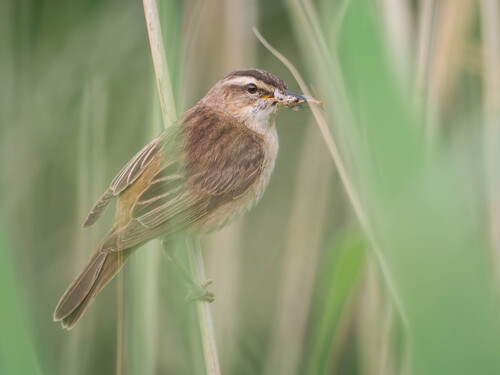
Sedge Warbler
Acrocephalus schoenobaenus
A boisterous and bold songster of the wetlands, the Sedge Warbler is easily identified by its striking white 'eyebrow' and its habit of mimicking other birds in a rapid-fire chatter.
Quick Identification
Size
Length: 11.5–13 cm (4.5–5.1 in); Wingspan: 17–21 cm (6.7–8.3 in); Weight: 10–15 g (0.35–0.53 oz)
Colors
Brown and black streaked upperparts, creamy-white underparts with buff-tinted flanks; featuring a prominent broad, pale cream supercilium (eyebrow stripe) above a dark eye-stripe.
Key Features
- Broad creamy-white eyebrow stripe (supercilium)
- Strongly streaked dark brown and tan back
- Unstreaked, pale creamy-buff underparts
- Short, pointed bill and restless, fluttering flight
When You’ll See Them
Behavior
Sedge Warblers are high-energy, restless birds that spend most of their time darting through dense aquatic vegetation. Unlike some of their more secretive relatives, the Sedge Warbler is quite bold, often climbing to the top of a reed stem or low bush to deliver its complex, chattering song. They are famous for their vocal ability, frequently incorporating mimicry of other birds into their own melodies, creating a chaotic but rhythmic sound that can be heard even throughout the night during the peak of the breeding season.
As long-distance migrants, these birds exhibit fascinating social behaviors related to their journey. Before departing for their wintering grounds south of the Sahara, they become solitary and highly focused on feeding, doubling their body weight in fat to fuel their non-stop flight across the desert. In a backyard setting, they are typically solitary visitors, though you may see territorial disputes between males near prime nesting sites in early spring.
EverydayEarth exclusive
Camera Tips
To capture the Sedge Warbler, placement is everything. Since these birds are low-level foragers that prefer the interface between water and thick vegetation, mount your camera no higher than 1-2 feet off the ground. Aim the lens at 'perch points'—stiff reed stems, low-hanging willow branches, or fence posts that sit just above the level of tall grass or water. These are the stages where males will stop to sing and defend their territory, providing the best opportunity for a clear, unobstructed shot.
Because the Sedge Warbler is a small, fast-moving subject, use a high-speed trigger setting and consider a camera that supports 4K video or a high frame rate. They have a habit of 'shivering' their wings while singing, which can look like a blur in photos but looks spectacular in high-definition video. If your camera has a 'pre-fire' or 'pro-capture' mode, enable it to catch the moment they dive back into the reeds after a song.
While they don't frequent traditional bird feeders, you can lure them toward your lens by creating a 'micro-habitat' near a water feature. If you have a pond, allow the grass on one side to grow long and seed. Sedge Warblers are attracted to the insect life found in undisturbed, damp vegetation. Setting your camera's motion sensitivity to high is crucial here, as their light weight and quick movements might not trigger less sensitive PIR sensors.
Timing is critical for the best footage. The last week of April and the first two weeks of May are the 'golden window' when males are most active and visible while establishing territories. During this time, they are much less shy. Early morning light provides the best illumination for their streaked plumage; positioning your camera with the sun at your back will help highlight the contrast of the dark streaks against their warm brown wings and that iconic white eyebrow.
Frequently Asked Questions
Record Sedge Warbler at your habitat
Connect a camera to start building your own species record — AI identifies every visitor automatically.