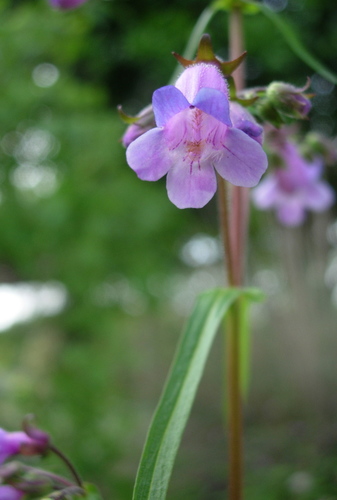
Sharpsepal Beardtongue
Penstemon tenuis
A lavender gem of the Southern wetlands, the Sharpsepal Beardtongue is a tall, elegant perennial that transforms damp garden corners into a bustling sanctuary for hummingbirds and bees.
Quick Identification
Size
Height of 60–120 cm (24–48 inches) with a spread of 30–60 cm (12–24 inches)
Colors
Pale lavender to violet-purple tubular flowers; inner throat features dark purple nectar guide lines; foliage is a medium to deep green
Key Features
- Bell-shaped lavender flowers with distinct internal stripes
- Sharply pointed (acuminate) sepals at the base of each bloom
- Tall, slender flower spikes arising from a basal rosette
- Narrow, lance-shaped leaves with finely serrated edges
When You’ll See Them
Geographic range
Where Does the Sharpsepal Beardtongue Live?
The Sharpsepal Beardtongue is a North American native with a highly specialized range focused on the Gulf Coast and south-central United States. It is endemic to four specific states: Texas, Louisiana, Mississippi, and Arkansas, where it thrives in the rich, silty soils left by the region's river systems. While it is a lowland specialist of the West Gulf Coastal Plain, it has become increasingly popular in managed landscapes across the American Southeast for its resilience in boggy conditions.
Basemap © OpenStreetMap contributors
Behavior
The Sharpsepal Beardtongue is a perennial wildflower that serves as a cornerstone of the spring ecosystem in the American South. Unlike many showy garden hybrids, this species is built for the humidity and heavy soils of the Gulf Coast. It grows in tidy, non-aggressive clumps, sending up elegant floral spikes that bloom sequentially from the bottom up, providing a steady supply of nectar over several weeks.
This plant exhibits a fascinating "social" relationship with native insects. The common name 'beardtongue' refers to the sterile stamen (the staminode) that sits at the base of the flower, which is covered in tiny hairs. This structure forces visiting bees to squeeze past the reproductive parts of the flower, ensuring efficient pollination. In the backyard, it is a peaceful but busy hub, often swaying gently in the breeze while supporting a variety of specialized pollinators.
EverydayEarth exclusive
Camera Tips
To successfully capture wildlife interacting with Sharpsepal Beardtongue, your camera placement should be stationary and focused on the flower spikes during the peak blooming months of April and May. Use a garden stake or tripod to mount your camera approximately 30 inches off the ground. Angle the lens slightly downward to capture the full length of the bloom spike, as hummingbirds tend to visit the top blossoms while bumblebees often start at the bottom.
Since this species thrives in damp areas, ensure your camera housing is rated for high humidity and localized moisture. If you are using an AI-powered camera like those from EverydayEarth, set your detection parameters for 'small birds' and 'insects.' The most dramatic footage usually occurs in the mid-morning when the sun first hits the lavender blooms, triggering a rush of pollinator activity. Avoid placing the camera in a way that faces the direct afternoon sun, which can wash out the delicate violet colors of the petals.
For the best results, look for the 'peak' of the spike—when the middle third of the flowers are open. This is when the plant is most attractive to wildlife. If your camera has a high-frame-rate setting, use it to capture the rapid wingbeats of the clearwing moths and Ruby-throated Hummingbirds that are frequent visitors to this specific Penstemon. Because the stems are tall and thin, they can sway significantly in the wind; using a 'zone detection' feature to focus on the static area where the flowers are clustered can help prevent false triggers from moving leaves.
Similar Species
Species that look similar or are commonly confused with Sharpsepal Beardtongue.
Frequently Asked Questions
Record Sharpsepal Beardtongue at your habitat
Connect a camera to start building your own species record — AI identifies every visitor automatically.