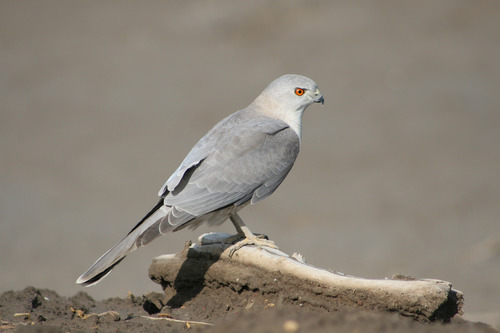
Shikra
Tachyspiza badia
Meet the Shikra, the spirited 'pocket hawk' of the suburbs. This small but mighty raptor is a master of ambush, turning any backyard garden into its personal hunting ground with lightning speed and precision.
Quick Identification
Size
Length 26–30 cm (10–12 in); Wingspan 50–70 cm (20–28 in); Weight 100–190 g (3.5–6.7 oz)
Colors
Adults have pale blue-grey upperparts and white underparts with fine rufous-brown barring. Males feature distinct orange-red irises, while females have yellow-orange eyes and slightly browner backs.
Key Features
- Short, rounded wings and a long, narrow tail
- Fine horizontal rufous barring on the breast and belly
- Distinctive sharp, two-note 'ti-tui' call
- Yellow cere and legs with dark talons
When You’ll See Them
Behavior
The Shikra is a bold and versatile raptor that has adapted remarkably well to human-dominated landscapes. Often seen perched on telephone wires or hidden within leafy canopies, these birds are masters of the ambush. They use a classic 'flap-and-glide' flight pattern to move between perches, staying low to the ground to surprise their prey from behind cover.
Despite their small size, they are incredibly territorial and protective of their nesting sites. In urban and suburban gardens, they are often the 'top dogs' of the backyard bird world, frequently causing a sudden hush among songbirds when they fly into view. They are solitary hunters but can be seen in pairs during the breeding season, performing high-circling aerial displays and calling loudly to establish their territory.
EverydayEarth exclusive
Camera Tips
Capturing a Shikra on camera requires focusing on their hunting habits. These hawks are creatures of habit and will often use the same high, exposed perch—like a fence post, a bare branch, or a clothesline—to survey the area. Position your camera at a height of 5 to 8 feet, angled slightly upward if aiming at a known perch, or level if monitoring a bird bath. Using a 'fast' shutter speed or high-frame-rate video setting is essential, as their strikes are lightning-fast and can appear as a blur on standard settings.
While you should never bait a raptor with meat, you can leverage their natural hunting instincts. Placing your camera near a busy songbird feeder or a stone wall known to house lizards will significantly increase your chances of a sighting. The Shikra will monitor these 'prey hotspots' from a distance before diving in. Ensure your camera has a wide-angle lens or is placed far enough back to capture the approach, as they often sweep in from the side rather than landing directly in front of the lens.
Seasonal timing is also key for the best footage. During the breeding months, Shikras become much more vocal and active near their nest sites. If you notice a pair frequenting a specific tree, set up your camera to monitor the flight paths leading to it. Early morning light provides the best illumination for their grey plumage and helps highlight the fine barring on their chest, which is a key identification mark for AI-powered cameras. If using a motion-triggered camera, set the sensitivity to high, as their small profile and speed might not trigger less sensitive sensors.
Similar Species
Species that look similar or are commonly confused with Shikra.
Eurasian Sparrowhawk
The Sparrowhawk usually has darker grey upperparts and more pronounced, darker barring on the underparts compared to the Shikra.
Besra
The Besra has a prominent dark vertical stripe down the center of its throat (mesial stripe) which is much fainter or entirely absent in the Shikra.
Frequently Asked Questions
Record Shikra at your habitat
Connect a camera to start building your own species record — AI identifies every visitor automatically.