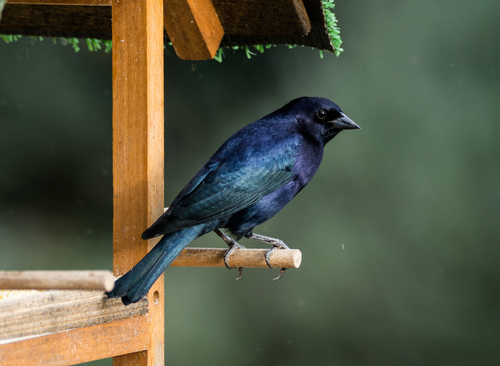
Shiny Cowbird
Molothrus bonariensis
A master of opportunism with a coat of shimmering violet, the Shiny Cowbird is a fascinating visitor to open landscapes. Watch as these clever birds navigate the suburban world with a bold, social spirit.
Quick Identification
Size
Length: 18–22 cm (7–8.5 in); Weight: 31–65 g (1.1–2.3 oz); Wingspan: 30–35 cm (12–14 in)
Colors
Males are uniformly black with a high-gloss iridescent violet or blue sheen; females are a duller grey-brown, typically paler on the underparts with a faint streak over the eye.
Key Features
- Deep violet-blue iridescence on males
- Short, thick conical bill
- Uniformly grey-brown plumage on females
- Frequent ground-foraging posture with tail held slightly upward
When You’ll See Them
Behavior
The Shiny Cowbird is a highly social and intelligent bird, often seen traveling in small groups or mixed-species flocks with other blackbirds and grackles. They are most famous—or perhaps infamous—for being obligate brood parasites. Unlike most birds, they do not build their own nests or raise their own young; instead, females secretly lay their eggs in the nests of over 250 other bird species, leaving the host parents to provide all the care. This opportunistic lifestyle allows them to spend more time foraging and socializing.
In a backyard setting, they are bold and adaptable. You will frequently see them walking along the ground rather than hopping, scanning for insects or fallen seeds. They are quite comfortable around humans and often frequent suburban lawns, parks, and agricultural fields where the grass is kept short, making it easier for them to spot prey.
EverydayEarth exclusive
Camera Tips
To capture the best footage of Shiny Cowbirds, focus your camera on ground-level foraging areas. These birds spend the majority of their active hours walking across the turf. Place your camera roughly 6 to 12 inches off the ground, angled slightly upward. This low perspective not only captures their unique 'walking' gait but also positions the lens to catch the light hitting the male's feathers, which is essential for showcasing that signature violet iridescence.
Food is the best lure for this species. They are highly attracted to platform feeders or simply birdseed scattered on a flat rock or bare patch of earth. Use a mix containing white proso millet, cracked corn, or sunflower hearts. If you have a birdbath, keep the water shallow; Shiny Cowbirds are frequent bathers and providing a clean water source can lead to excellent action shots of them splashing and preening.
Because they are quick and often travel in groups, use a camera with a fast trigger speed (0.5 seconds or less) and set it to 'Burst Mode' or a short video clip (10-15 seconds). This increases your chances of capturing the moment a male performs his courtship display—puffing out his chest feathers and bowing while letting out a squeaky, metallic whistle.
Lighting is critical for this species. Because the males are so dark, they can appear as 'black blobs' in harsh midday sun or deep shade. Position your camera so the sun is behind the lens during the early morning or late afternoon. This 'golden hour' light will illuminate the iridescent blue and purple tones that make the Shiny Cowbird live up to its name.
Similar Species
Species that look similar or are commonly confused with Shiny Cowbird.
Brown-headed Cowbird
The male has a distinct brown head contrasting with a black body, whereas the Shiny Cowbird is iridescent purple-black all over.
Bronzed Cowbird
Bronzed Cowbirds have striking red eyes and a thicker neck 'ruff' compared to the dark eyes of the Shiny Cowbird.
Carib Grackle
Grackles have much longer, keel-shaped tails and bright yellow eyes, while Shiny Cowbirds have short tails and dark eyes.
Frequently Asked Questions
Record Shiny Cowbird at your habitat
Connect a camera to start building your own species record — AI identifies every visitor automatically.