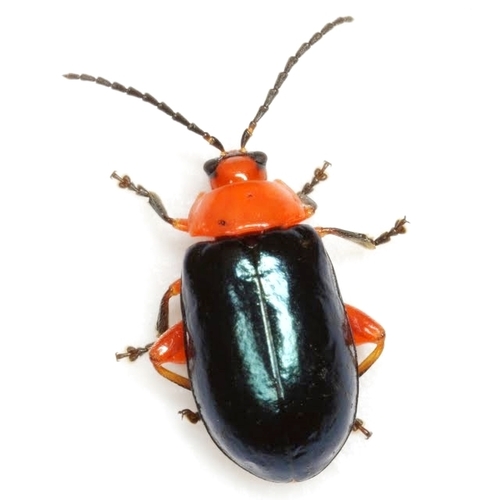
Shiny Flea Beetle
Asphaera lustrans
A miniature marvel of the insect world, the Shiny Flea Beetle dazzles with its metallic blue shell and golden spots. Known for its incredible jumping ability, this tiny beetle is a highlight for any backyard macro-photographer.
Quick Identification
Size
7–9 mm (0.27–0.35 inches) in length
Colors
Bright orange or yellow pronotum and head; metallic dark blue or black elytra (wing covers) featuring four distinct yellow spots (two on each wing cover).
Key Features
- Enlarged hind femora designed for jumping
- Metallic, high-gloss finish on wing covers
- Four prominent pale yellow spots on dark elytra
- Oval, convex body shape
When You’ll See Them
Geographic range
Where Does the Shiny Flea Beetle Live?
The Shiny Flea Beetle is a native inhabitant of the Americas, with a geographic range that stretches from the southern United States through Central America. It is most frequently documented in the southwestern US and Texas, following a distribution path southward through the varied landscapes of Mexico. These beetles are also commonly found in the tropical and subtropical environments of Guatemala, Costa Rica, and Panama, wherever their specific host plants thrive.
Basemap © OpenStreetMap contributors
Behavior
Like other members of the tribe Alticini, the Shiny Flea Beetle is famous for its powerful "flea-like" jump. This is made possible by an enlarged femur in the hind legs containing a spring-like mechanism that allows the beetle to catapult itself away from predators in the blink of an eye. When they aren't leaping, they are typically found crawling slowly across the leaves of their preferred host plants, where they feed and mate.
These beetles are generally solitary foragers but can be found in small groups where host plants are abundant. They are most active during the warmer daylight hours, basking in the sun to regulate their temperature. While they are relatively small, their striking metallic colors make them stand out against green foliage, though their quick escape reflex makes them a challenge for backyard observers to catch in hand.
EverydayEarth exclusive
Camera Tips
Capturing a Shiny Flea Beetle on an AI-powered camera requires a specialized macro-focused approach. Because these beetles are less than a centimeter long, standard trail cameras will likely miss them unless they have a dedicated macro lens or are positioned extremely close—within 4 to 8 inches—of a "perch" or host plant. Aim your camera at the upper leaves of native mints, salvias, or sunflowers, as these are the primary stages where the beetles bask and feed during the heat of the day.
Lighting is your best friend when trying to identify this species. The "shiny" in their name comes from the metallic luster of their elytra; positioning your camera so it receives side-lighting from the morning or late afternoon sun will make those four yellow spots pop and help the AI distinguish the beetle from the dark shadows of the foliage. Avoid using a heavy flash, which can create a "blowout" effect on their reflective shells, making identification difficult.
Since these beetles are highly sensitive to movement and will jump at the slightest vibration, a stationary, motion-activated camera is much more effective than handheld photography. If you are setting up a backyard wildlife station, planting a small patch of native Lamiaceae (mint family) will act as a natural lure. Ensure the camera's shutter speed is high if possible, as their jumping reflex is one of the fastest in the insect world, and you’ll want a crisp image before they vanish from the frame.
Frequently Asked Questions
Record Shiny Flea Beetle at your habitat
Connect a camera to start building your own species record — AI identifies every visitor automatically.