Shortbeak Sedge
Carex brevior
A resilient North American native, Shortbeak Sedge is the unsung hero of the prairie, providing elegant copper-toned seed heads and essential habitat for backyard wildlife.
Quick Identification
Size
Height ranges from 30 to 100 cm (12 to 39 inches); individual seed heads are approximately 1 to 1.5 cm long.
Colors
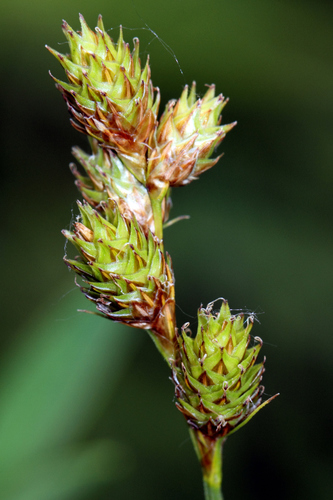
Bright emerald green foliage in spring; seed heads (perigynia) turn from light green to straw-brown or copper-bronze as they mature.
Key Features
- Clump-forming (cespitose) growth habit
- Oval-shaped, distinctively flattened seed spikes
- Short beaks on the perigynia (seeds)
- Winged margins along the edges of the seeds
When You’ll See Them
Geographic range
Where Does the Shortbeak Sedge Live?
Shortbeak Sedge is a native powerhouse of North America, boasting an expansive range that stretches from the southern provinces of Canada down through almost the entirety of the United States. It is particularly dominant across the Great Plains and the Midwest, though it is also found in scattered populations in the Northeast and Pacific Northwest. This species has also been documented in parts of Northern Mexico, making it one of the most widely distributed sedges on the continent.
Basemap © OpenStreetMap contributors
Behavior
Shortbeak Sedge is a versatile, cool-season perennial that begins its growth cycle early in the spring. Unlike many turf grasses that spread via aggressive underground runners, this species grows in neat, reliable clumps. It spends its early energy developing upright stems (culms) topped with flower spikes that appear in late spring or early summer, providing critical structure to prairie and meadow ecosystems.
While it may seem stationary, Shortbeak Sedge is highly interactive with its environment. It serves as a primary host plant for various caterpillar species and its dense foliage offers ground-level shelter for small mammals and reptiles. As the seeds ripen in mid-to-late summer, they become a high-energy food source for ground-feeding birds. In backyard settings, it is valued for its ability to handle both drought and occasional flooding, making it a 'workhorse' plant for rain gardens and naturalized borders.
EverydayEarth exclusive
Camera Tips
To capture the best images of Shortbeak Sedge with an AI-powered camera, position your device at a low 'worm’s-eye' view. Setting the camera roughly 6 to 10 inches off the ground allows you to frame the architectural beauty of the seed heads against the sky or a contrasting backdrop. This angle is also perfect for spotting the many insects, like skippers and satyr butterflies, that use the sedge as a host plant.
Because sedges move gracefully in the wind, use a faster shutter speed or high-sensitivity motion trigger if you want to avoid blur. However, the movement itself can be a beautiful subject for time-lapse videos. Set your camera to take a photo every 15 minutes during the spring growth spurt to see the clumps 'explode' into height, or use a daily capture to document the seeds changing color from vibrant green to deep bronze.
If your goal is to capture wildlife interacting with the plant, place your camera near a established clump during late July and August. This is when the seeds are most attractive to birds like sparrows and juncos. Since sedges are often found in transition zones between lawns and woods, aim your camera toward the edge of the foliage where small mammals like rabbits might use the plant for cover before venturing into the open.
For the best lighting, prioritize 'Golden Hour'—the hour after sunrise or before sunset. The low-angled light catches the translucent 'wings' of the Shortbeak Sedge's seeds, making them appear to glow. If your camera has a macro or close-focus mode, use it to highlight the unique 'oval' shape of the spikes, which is the key identifying feature for this species.
Frequently Asked Questions
Record Shortbeak Sedge at your habitat
Connect a camera to start building your own species record — AI identifies every visitor automatically.