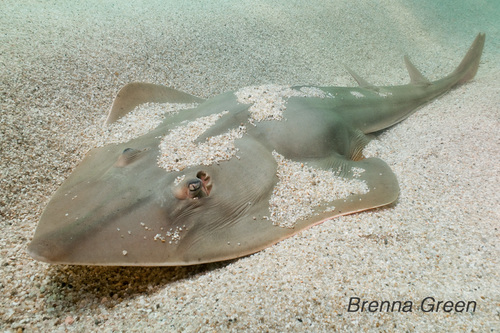
Shovelnose Guitarfish
Pseudobatos productus
The ultimate master of disguise, the Shovelnose Guitarfish is a prehistoric survivor that patrols our sandy shores with effortless grace. Neither fully shark nor fully ray, this gentle coastal resident is a highlight for any underwater observer.
Quick Identification
Size
Typically 3-5 feet (0.9-1.5 meters) in length; weighs between 15-40 lbs (6.8-18 kg)
Colors
Sandy brown, olive, or tan upper body with subtle dark freckling; underside is a clean, creamy white
Key Features
- Pointed, shovel-shaped rostrum (snout)
- Flattened ray-like forebody with a thick, shark-like tail
- Two large dorsal fins located far back on the body
- Lacks a stinging tail spine
When You’ll See Them
Sightings on EverydayEarth
Mar 31, 2026
A Shovelnose Guitarfish glides gracefully across the sandy seafloor of the kelp forest, moving past small patches of algae and debris.
Mar 30, 2026
A Shovelnose Guitarfish glides gracefully across the sandy substrate of a kelp forest, its wing-like pectoral fins and powerful tail providing steady propulsion as it searches the seafloor. In the background, a vibrant orange Garibaldi and a Kelp Bass are seen swimming through the amber-colored kelp fronds and patches of red algae.
Behavior
The Shovelnose Guitarfish is a fascinating evolutionary bridge between sharks and rays, often described as a shark that has been flattened by a steamroller. They are highly specialized bottom-dwellers, spending a significant portion of their lives partially buried in the sand or mud. By pumping water over their gills through small openings behind their eyes called spiracles, they can stay perfectly still for hours, waiting for an incoming tide or a potential meal to pass by.
While they are solitary hunters, they are surprisingly social during the late spring and summer months when they congregate in shallow estuaries and bays to mate and give birth to live young. For humans, they are completely harmless and are often characterized by their docile nature; they would rather swim away or rely on their impeccable camouflage than confront a snorkeler or wade-fisher.
EverydayEarth exclusive
Camera Tips
To successfully film a Shovelnose Guitarfish, you will need a specialized underwater setup or a pole-mounted camera system if you are monitoring from a dock or pier. Because these fish are bottom-dwellers, your camera must be positioned as close to the substrate as possible. A weighted 'crab-trap' camera mount or a weighted PVC frame works best to keep the lens steady against the pull of the tide. Angle the camera slightly downward, roughly 10-15 degrees, to capture the guitarfish’s unique silhouette as it glides over the sand.
Visibility is your biggest challenge in coastal 'backyards.' Always aim to record during the 'flood tide'—the period when clean, clear ocean water moves into the bays and estuaries. This reduces the amount of suspended sediment and 'marine snow' that can confuse AI motion sensors. If you are using an AI-powered camera like those supported by EverydayEarth, set the sensitivity to high; the guitarfish’s incredible camouflage is designed to fool the eye, and it can sometimes fool a motion sensor if the lighting is flat.
If you have a private dock or access to a calm lagoon, you can attract these rays naturally by placing the camera near a bed of eelgrass or a patch of sand rich in shellfish. Do not use floating bait, as this will attract surface scavengers like gulls. Instead, a small mesh bag of crushed crabs or shrimp secured to the camera mount can create a scent trail that draws the guitarfish directly into the frame. For the best visual results, use a wide-angle lens and set your resolution to 4K at 60fps, which will allow you to see the beautiful, undulating movement of their tail in slow motion during playback.
Similar Species
Species that look similar or are commonly confused with Shovelnose Guitarfish.
Frequently Asked Questions
Record Shovelnose Guitarfish at your habitat
Connect a camera to start building your own species record — AI identifies every visitor automatically.