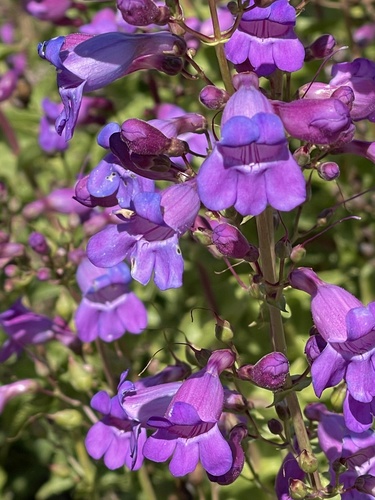
Showy Penstemon
Penstemon spectabilis
A towering icon of the California chaparral, the Showy Penstemon dazzles with its electric blue spikes and serves as a vital nectar hub for hummingbirds and native bees.
Quick Identification
Size
Grows 60–150 cm (2–5 feet) tall; individual flowers are 2.5–3.5 cm (1–1.5 inches) long
Colors
Vibrant blue and violet tubular flowers, often with pinkish-purple throats; glaucous grayish-green foliage
Key Features
- Tall, vertical flower spikes packed with trumpet-shaped blossoms
- Large, opposite, serrated leaves that wrap around the stem
- Flowers transition from pinkish-purple at the base to deep blue at the lobes
When You’ll See Them
Geographic range
Where Does the Showy Penstemon Live?
This stunning wildflower is a specialty of the Southwestern corner of North America. Its primary range is concentrated in the coastal mountain ranges and inland valleys of Southern California, extending from the Transverse Ranges through the Peninsular Ranges and southward into northern Baja California, Mexico. It thrives in the Mediterranean climate of this region, favoring sun-drenched slopes where it can find the drainage it needs to survive the winter rains.
Basemap © OpenStreetMap contributors
Behavior
Ecologically, this plant is a hub of activity. It provides a vital bridge of nutrients during the transition from wet spring to dry summer. While it doesn't 'behave' in the animal sense, it responds dynamically to its environment, leaning toward light sources and entering a semi-dormant state during the harsh heat of late August to conserve moisture. It is a favorite of native gardeners because it requires almost no human intervention once established.
EverydayEarth exclusive
Camera Tips
While the plant itself is the subject, the real action comes from its visitors. Set your camera to a fast trigger speed or 'Burst Mode' to catch the rapid movements of hummingbirds or large carpenter bees that frequent the blooms. Since these pollinators are most active during the bright morning hours, ensure your camera's exposure settings are dialed back slightly to prevent the brilliant purple hues from 'clipping' or losing detail in the intense California sun.
If you are using an AI-powered camera to monitor wildlife, place the unit approximately 3 to 4 feet away from the tallest stalk. This distance allows the AI to distinguish between the floral background and incoming visitors like the Allen’s Hummingbird or various Sphinx moths. For a unique night-time perspective, use a camera with high-quality infrared or a low-glow flash to see if any nocturnal insects are using the plant as a resting spot or late-night nectar source.
Frequently Asked Questions
Record Showy Penstemon at your habitat
Connect a camera to start building your own species record — AI identifies every visitor automatically.