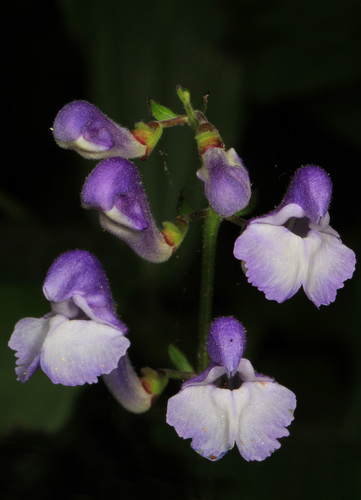
Showy Skullcap
Scutellaria serrata
A crown jewel of the spring forest, the Showy Skullcap enchants with its pairs of vivid blue, hooded blossoms. Found in the rich woods of the Eastern US, this elegant perennial is a favorite for shade-loving pollinators.
Quick Identification
Size
Grows 30–60 cm (12–24 inches) tall with leaves 5–10 cm (2-4 inches) long
Colors
Brilliant violet-blue to sky-blue flowers with white markings on the lower lip; deep green foliage
Key Features
- Two-lipped, hooded blue flowers arranged in pairs
- Square stems characteristic of the mint family
- Coarsely serrated (saw-toothed) leaf margins
When You’ll See Them
Behavior
Showy Skullcap is a perennial wildflower that brings a sophisticated touch to the forest floor. Emerging in early spring, it grows in upright, tidy clumps rather than spreading aggressively like some of its mint relatives. It spends the majority of its life cycle as a dormant rhizome beneath the soil, waiting for the increasing light and warmth of April to send up its square-shaped stems.
During its blooming period in late spring, the plant becomes a focal point for local pollinators. Because the flowers are tubular and hooded, they require specialized visitors—mostly long-tongued bees—that have the strength to push past the petals to reach the nectar. In a backyard setting, this plant acts as a quiet anchor for shade gardens, staying stationary and dependable year after year, provided the soil remains rich and moist.
EverydayEarth exclusive
Camera Tips
To capture the Showy Skullcap effectively, shift your trail camera into 'Time Lapse' mode rather than relying solely on motion triggers. Because plants move slowly, setting the camera to take an image every 15 to 30 minutes during daylight hours will allow you to create a stunning sequence of the buds opening or the plant swaying in the forest breeze. This method is far more reliable for stationary subjects than traditional PIR triggers.
Placement is crucial for this species. Mount your camera on a short garden stake or a specialized ground mount about 12 inches off the forest floor. Angle the lens slightly upward to emphasize the 'showy' nature of the flower spikes against the canopy. If you are hoping to catch pollinators in action, place the camera approximately 2 to 3 feet away from the blooms to ensure they are within the focal range. High-definition video mode with a 10-second duration is excellent for capturing the exact moment a bumblebee enters the hooded flower.
Lighting in deep woods can be tricky for AI-powered cameras. Position your camera facing north or south to avoid the 'blown-out' effect of direct morning or evening sun hitting the blue petals. Dappled sunlight provides the best color accuracy for the vibrant violet hues of the Showy Skullcap. If your camera allows for sensitivity adjustments, set it to 'High' to ensure that the subtle movement of a pollinator landing on a flower is enough to trigger a recording.
Check your camera's field of view for distracting foreground elements. Small twigs or blades of grass that are too close to the lens will appear as blurry blobs and can confuse the AI's identification software. Clear a small 1-foot radius around the plant of any debris that might whip in the wind, which helps prevent false triggers and ensures the Showy Skullcap remains the star of the frame.
Similar Species
Species that look similar or are commonly confused with Showy Skullcap.
Frequently Asked Questions
Record Showy Skullcap at your habitat
Connect a camera to start building your own species record — AI identifies every visitor automatically.