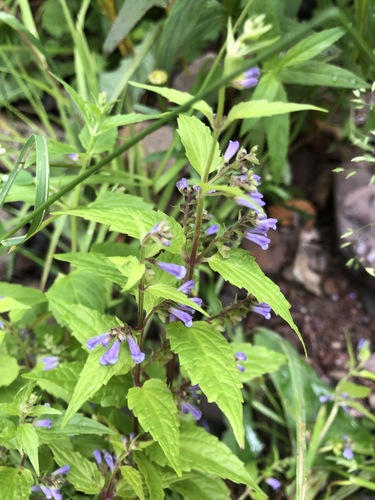
side-flowering skullcap
Scutellaria lateriflora
A delicate late-summer gem, the side-flowering skullcap is a favorite for native pollinators. Its unique, helmet-shaped flowers provide a masterclass in specialized botanical engineering.
Quick Identification
Size
Stands 30-90 cm (1-3 feet) tall; individual flowers are 6-10 mm (0.25-0.4 inches) long.
Colors
Pale blue to violet-blue tubular flowers; square green or reddish-purple stems; medium-green serrated leaves.
Key Features
- One-sided flower clusters (racemes) emerging from leaf axils
- Square stems with opposite, egg-shaped leaves
- Calyx has a protruding ridge resembling a miniature helmet or skullcap
- Small, snapdragon-like blue flowers with a white patch on the lower lip
When You’ll See Them
Behavior
Side-flowering skullcap is a hardy perennial that brings structure and subtle color to the wetter corners of a backyard. Unlike many members of the mint family, it spreads gently via rhizomes rather than taking over the entire garden. It is a late-season bloomer, filling a critical gap in the nectar calendar when other spring flowers have faded. Its growth habit is upright and branching, often leaning slightly toward the light if planted in partial shade.
From a wildlife perspective, this plant is a busy transit hub. Because of the flower's tubular shape, it is specifically adapted for pollinators with long tongues, such as bumblebees and certain butterflies. Watching these insects interact with the plant is fascinating; they must physically push into the flower to reach the nectar, often resulting in a dusting of pollen on their heads. It is a peaceful, non-invasive species that provides a high-quality food source for native beneficial insects.
EverydayEarth exclusive
Camera Tips
To capture the side-flowering skullcap effectively, position your camera at a low 'insect-eye' level, roughly 12 to 18 inches off the ground. This angle allows you to see into the tubular flowers and catch the action as pollinators arrive. Since this plant thrives in moist areas, ensure your camera mount is stable in soft soil—a tripod with wide feet or a stake mount works best. Angle the camera to face the 'side' of the stems where the flowers are most concentrated to highlight the unique one-sided blooming habit that gives the plant its name.
Because the primary goal is often to capture the insects visiting the plant, use a 'macro' or close-up lens setting if your AI camera supports it. If you are using a motion-triggered trail camera, set the sensitivity to high; bees and butterflies are small and fast, so you want a quick trigger speed to catch them mid-visit. Avoid placing the camera in direct, harsh midday sun which can wash out the delicate blue-violet hues of the petals. Instead, aim for a spot that receives dappled sunlight or use a north-facing orientation to ensure even lighting throughout the day.
Wind is your biggest challenge with this species. The tall, thin stems of side-flowering skullcap sway easily, which can cause hundreds of 'false' triggers on a motion-sensing camera. To mitigate this, use a camera with a 'zone' setting to focus only on the flower heads, or place a small decorative garden stake behind the plant to provide a bit of wind stability. For the most compelling footage, set your camera to record short 10-second video clips rather than still photos. This captures the 'dance' of the bumblebees as they pry open the flowers, offering a much more intimate look at the backyard ecosystem than a static image ever could.
Similar Species
Species that look similar or are commonly confused with side-flowering skullcap.
Frequently Asked Questions
Record side-flowering skullcap at your habitat
Connect a camera to start building your own species record — AI identifies every visitor automatically.