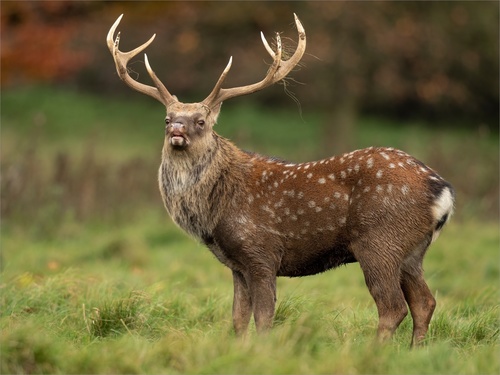
Sika Deer
Cervus nippon
Known as the 'Miniature Elk' for their vocal nature and majestic presence, the Sika Deer is a master of the forest edge. With their permanent spots and striking white rumps, they are one of the most photogenic visitors to your backyard camera.
Quick Identification
Size
Length: 100-160 cm (3.3-5.2 ft); Shoulder height: 50-95 cm (20-37 in); Weight: 30-70 kg (66-154 lbs)
Colors
Chestnut brown with white spots in summer; transitions to dark brown or charcoal grey in winter. Features a prominent white, heart-shaped rump patch.
Key Features
- White spots often remain visible on adults in summer coat
- Prominent heart-shaped white rump patch
- Short, upright mane on the neck of stags
- High-pitched whistling or 'screaming' vocalization
When You’ll See Them
Behavior
Sika Deer are highly social but often segregate by sex for most of the year, with stags and hinds forming separate bachelor and maternal groups. They are significantly more vocal than most other deer species, using a wide array of sounds from goat-like bleats to eerie, high-pitched whistles during the rutting season. Unlike the more flighty White-tailed deer, Sika are known for their 'stotting' or 'pronking' gait—a stiff-legged jump used when they are startled or playing.
These deer are remarkably adaptable and have earned the nickname 'Miniature Elk' due to their similar rutting behaviors and physical proportions. In areas where they have been introduced, such as the eastern United States and parts of Europe, they often inhabit dense marshlands and thickets that other deer species find too difficult to navigate. While they are generally shy, they can become quite bold in suburban settings where food is plentiful and they feel secure.
EverydayEarth exclusive
Camera Tips
When setting up your camera for Sika Deer, height is the most critical factor. Because Sika are shorter than White-tailed deer, you should mount your camera lower—approximately 24 to 30 inches off the ground. This ensures you capture their full body and those identifying white spots rather than just the top of their backs. Angle the camera slightly toward a known game trail or a 'rub' where a stag has stripped bark from a tree, as these are frequent return spots for dominant males during the autumn.
Sika Deer are particularly active in transitional habitats, such as the line where a forest meets a marsh or a suburban backyard. If you live in an area where they are present, look for 'scrapes' in the soil—patches where the deer have cleared the leaves away. These deer are highly curious, so a standard salt block or a mineral lick (where legal) can be an excellent lure to keep them in front of the lens long enough for a clear identification. During the rut (September through November), stags are very active and less cautious, making it the prime time for capturing dramatic footage of antler displays.
Because Sika are known for their quick, sudden movements and 'stotting' behavior, use a camera with a fast trigger speed—ideally under 0.5 seconds. Set your device to 'Burst Mode' or 'Photo + Video' to capture the full sequence of their movement. Sika are famously vocal; if your camera supports audio recording, ensure it is enabled. You might catch the haunting, multi-syllabic whistle of a stag during the night, which is one of the most distinctive and eerie sounds of the wild.
Similar Species
Species that look similar or are commonly confused with Sika Deer.
Frequently Asked Questions
Record Sika Deer at your habitat
Connect a camera to start building your own species record — AI identifies every visitor automatically.