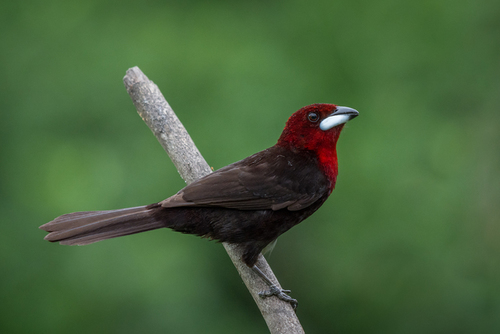
Silver-beaked Tanager
Ramphocelus carbo
The Silver-beaked Tanager is a masterpiece of contrast, featuring deep velvety maroon plumage and a bill that shines like polished chrome. A social and vocal visitor, this bird turns any tropical garden into a lively theater of color and sound.
Quick Identification
Size
18 cm (7 in) in length; wingspan of approximately 25 cm (10 in); weighs 25-31 g (0.8-1.1 oz)
Colors
Males are deep velvety crimson-black with a luminous silvery-white lower mandible; females are sooty brownish-maroon with a duller bill.
Key Features
- Massive silvery-white lower mandible
- Velvety maroon-black plumage in males
- Dull reddish-brown rump on females
- Heavy, thick-based bill
When You’ll See Them
Behavior
Silver-beaked Tanagers are famously social and noisy birds, rarely seen alone. They typically move in restless groups of 4 to 10 individuals, likely family units, that travel through the mid-to-lower levels of the forest canopy and garden shrubbery. They are known for their constant vocalizations, primarily a sharp 'chink' call that keeps the group synchronized as they hop through dense foliage.
These birds are quite bold and adapt well to human environments, often becoming a staple sight at bird feeders in South American gardens. While they are territorial during the nesting season, they spend most of the year in these 'chattering' flocks, often serving as the nucleus for mixed-species foraging groups that include other tanagers and honeycreepers. Their movement is jerky and energetic, making them a lively addition to any backyard.
EverydayEarth exclusive
Camera Tips
To capture the striking contrast of the male Silver-beaked Tanager’s beak, position your camera at a height of 3 to 5 feet, ideally facing a perching branch near a fruiting tree or feeder. These birds prefer the 'edge' of cover, so avoid placing cameras in wide-open spaces. A spot where sunlight filters through leaves is perfect; the 'velvety' texture of their feathers absorbs light, so direct, harsh midday sun can make them look like simple black silhouettes, while dappled light reveals their deep crimson highlights.
Attracting them to your lens is easiest with a fruit-based lure. Use a platform feeder or a 'spike' feeder to offer overripe bananas, papayas, or halved oranges. Because they travel in groups, you should set your camera's field of view slightly wider than you would for a solitary bird. If your camera allows for video, set it to record 15-20 second clips. This will allow you to capture their social interactions, as they often display to one another with flicking wings and head-bobbing around a food source.
Technical settings are crucial for this species due to the high contrast between their dark feathers and glowing bills. If your camera has exposure compensation, dial it down slightly (-0.5 or -1.0) to prevent the silvery beak from 'blowing out' into a white blur. Use a high-sensitivity motion trigger, as their movements are quick and 'twitchy.' During the rainy season, they are particularly active just after a downpour when insects are more accessible, so ensure your camera is well-shielded but active during these weather shifts.
Similar Species
Species that look similar or are commonly confused with Silver-beaked Tanager.
Frequently Asked Questions
Record Silver-beaked Tanager at your habitat
Connect a camera to start building your own species record — AI identifies every visitor automatically.