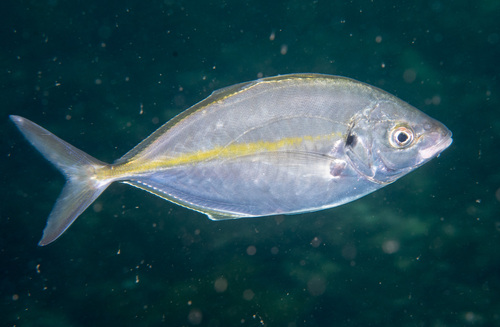
Silver Trevally
Pseudocaranx georgianus
A shimmering icon of the Southern Hemisphere's coastal waters, the Silver Trevally is a master of speed and social coordination. Whether patrolling a suburban jetty or a deep reef, their brilliant silver scales and acrobatic schooling make them a captivating subject for any underwater lens.
Quick Identification
Size
Typically 30-50 cm (12-20 inches), but can reach up to 94 cm (37 inches) and weigh over 10 kg (22 lbs).
Colors
Brilliant shimmering silver body with a pale greenish-blue back and a distinct yellow stripe along the lateral line. A small, dark spot is present on the edge of the gill cover.
Key Features
- Distinctive yellow lateral line stripe
- Small black spot on the operculum (gill cover)
- Deeply forked tail and compressed, oval-shaped body
- Protractile mouth that extends downward for feeding
When You’ll See Them
Behavior
Silver Trevally are highly social, energetic fish that typically travel in schools, ranging from a few individuals to massive shimmering clouds. They are opportunistic feeders, often seen patrolling estuaries and shallow reefs where they use their protractile mouths to suck up small invertebrates from the sandy floor. While they are powerful swimmers capable of bursts of speed, they are often quite inquisitive around divers and underwater structures.
In many coastal communities, these fish are a common sight around private jetties and boat ramps. They exhibit a blend of cautious intelligence and curiosity, often investigating any disturbance in the water that might signal a potential meal. Their social structure is vital for protection against larger predators like sharks and kingfish, as the 'many eyes' of the school help detect threats early and confuse attackers with synchronized movement.
EverydayEarth exclusive
Camera Tips
Capturing the Silver Trevally on an underwater 'trail cam' or action camera requires a focus on light and water clarity. Since they are naturally attracted to structure, the best placement for your camera is 1-2 meters below the surface, securely attached to a jetty pylon or a weighted tripod on a sandy patch near a reef edge. Aim your camera horizontally or slightly upward toward the surface to capture the sun reflecting off their scales; avoid shooting directly into the sun to prevent lens flare.
To encourage Silver Trevally to visit your camera's field of view, use a 'burley' or bait bag filled with crushed pilchards or breadcrumbs. Secure the bag about 1 to 1.5 meters in front of the lens. This creates a 'feeding zone' where the fish will congregate and stay for longer periods. These fish are sensitive to sudden movements, so a fixed, stationary mount is far superior to a handheld approach for capturing natural schooling behavior.
Timing is crucial for the best footage. The 'golden hours' of dawn and dusk provide soft lighting that makes their yellow lateral lines pop, and this is when their feeding behavior is most frantic. During high tide, they are more likely to move closer to shore and into estuary systems where your backyard or dock camera might be situated. In the summer months, look for schools following the incoming tide, as the clearer oceanic water provides much better visibility for your lens compared to the murky water of a low tide.
If your camera allows for custom settings, use a high frame rate (at least 60fps). Silver Trevally move with sudden, jerky bursts, and a higher frame rate will allow you to play back the footage in slow motion, revealing the incredible coordination of the school. If you are using a motion-activated camera, ensure the sensitivity is set high, as the silver flash of a passing fish is often enough to trigger a recording even from a distance.
Similar Species
Species that look similar or are commonly confused with Silver Trevally.
Frequently Asked Questions
Record Silver Trevally at your habitat
Connect a camera to start building your own species record — AI identifies every visitor automatically.