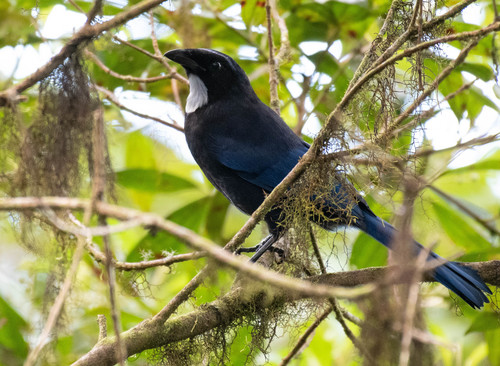
Silvery-throated Jay
Cyanolyca argentigula
A shimmering specter of the Talamanca highlands, the Silvery-throated Jay is a masterpiece of indigo and silver. This intelligent, high-altitude specialist is one of the most sought-after sightings in the cloud forests of Costa Rica and Panama.
Quick Identification
Size
25–27 cm (10–10.5 inches) in length; 55–70 g (1.9–2.5 oz) in weight
Colors
Deep navy to indigo blue body; silvery-white or pale violet-white throat; black facial mask; silvery-blue or white crown patch; dark legs and bill
Key Features
- Silvery-white throat patch contrasting with a black face
- Deep indigo plumage appearing almost black in low light
- Pale silvery-blue forehead and crown
- Slender, medium-sized jay with a long tail
When You’ll See Them
Geographic range
Where Does the Silvery-throated Jay Live?
The Silvery-throated Jay is a regional specialist native to the high-altitude mountain ranges of Central America. Its core range is strictly limited to the Cordillera Central and the Cordillera de Talamanca, stretching from central Costa Rica into western Panama. Within this narrow corridor, it is found almost exclusively in the mist-shrouded 'islands' of cloud forest that top these volcanic peaks.
Basemap © OpenStreetMap contributors
Behavior
The Silvery-throated Jay is a highly social and intelligent bird, typically moving through the forest in family groups of four to ten individuals. These groups are often heard before they are seen, communicating with a wide repertoire of metallic clicks, harsh rasps, and melodic whistles. They are active foragers, hopping through the mid-canopy and understory where they meticulously inspect moss, bromeliads, and epiphytes for hidden prey.
Unlike some of their more urban cousins, these jays are strictly forest-dependent and rarely venture far from dense cover. They are frequently observed participating in mixed-species foraging flocks, often acting as the group's sentinels because of their keen eyesight and loud alarm calls. In the presence of humans, they tend to be shy and elusive, retreating into the misty cloud forest foliage if they feel observed.
EverydayEarth exclusive
Camera Tips
To capture the Silvery-throated Jay on a trail camera, altitude is your most important factor. You must place your equipment in the high-elevation cloud forests above 2,000 meters. Because these birds rarely descend to the forest floor, mounting your camera at ground level is unlikely to yield results. Instead, secure your camera to a tree trunk 6 to 10 feet off the ground, overlooking a platform or a thick horizontal branch laden with moss and epiphytes, which are their favorite foraging spots.
These jays are highly attracted to water, especially in the dry season. Setting up a shallow, elevated birdbath or a dripping water feature within view of the camera can be a powerful lure. For food-based attractants, native fruits or a suet block can work, though you may need to 'pre-bait' the area for several days to get the resident family group accustomed to the site. They are wary of new objects, so using a camouflaged camera housing that blends into the mossy tree bark is highly recommended.
In the dimly lit environment of the cloud forest, camera settings are critical. Use a fast trigger speed and set your device to 'Burst Mode' to capture their quick, hopping movements. If your camera allows for ISO adjustment, set it slightly higher to account for the frequent fog and heavy canopy shade. The best time for filming is just after sunrise when the birds are most vocal and active in their search for breakfast.
Similar Species
Species that look similar or are commonly confused with Silvery-throated Jay.
Frequently Asked Questions
Record Silvery-throated Jay at your habitat
Connect a camera to start building your own species record — AI identifies every visitor automatically.