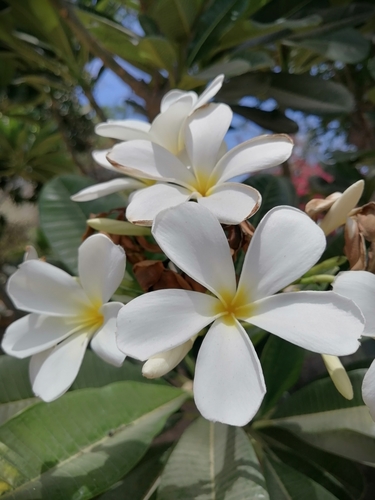
Singapore graveyard flower
Plumeria obtusa
With its iconic waxy blooms and heavenly scent, the Singapore graveyard flower is the crown jewel of the tropical backyard. Its glossy evergreen foliage and architectural branches make it a stunning subject for both day and night wildlife photography.
Quick Identification
Size
A small tree or large shrub reaching 10-25 feet (3-8 meters) in height with a spread of 10-20 feet (3-6 meters).
Colors
Lustrous white petals with a distinct yellow center (throat); foliage is a dark, glossy, deep green with pale undersides.
Key Features
- Five-petaled waxy white flowers with a yellow center
- Blunt, rounded leaf tips that lack a pointed apex
- Thick, sausage-like succulent branches that produce milky sap
- Leathery, dark green leaves up to 10 inches long
When You’ll See Them
Behavior
The Singapore graveyard flower is a slow-growing evergreen tree celebrated for its architectural form and intoxicating fragrance. Unlike many of its deciduous cousins, this species typically retains its foliage year-round in tropical climates, providing a consistent canopy of glossy, leathery leaves. It follows a rhythmic blooming cycle where clusters of flowers appear at the branch tips, often throughout the year, peaking during the warmest months.
This plant plays a vital role in its ecosystem by attracting long-tongued pollinators, particularly Sphinx moths, which are drawn to its heavy evening scent. While it produces no nectar, the plant 'cheats' by mimicking the scent of nectar-rich flowers to lure these insects. In human environments, it is prized for its ornamental beauty, though gardeners should be cautious of the milky white latex sap found in its branches, which can be irritating to the skin and eyes.
EverydayEarth exclusive
Camera Tips
Capturing the Singapore graveyard flower with an AI-powered camera offers a unique opportunity to document the secret life of its pollinators. To get the best results, mount your camera using a macro-lens attachment or set the focus to a close-range distance (1-3 feet) from a fresh cluster of blooms. Position the camera at eye-level with the branches rather than looking down from above; this allows you to see the structure of the flowers and any insects that land on the petals. Using a tripod or a fixed branch mount is essential to prevent motion blur during long-exposure or time-lapse shots.
Because the fragrance peaks at night to attract moths, we recommend using a camera with high-quality infrared (IR) night vision or a subtle, external warm-toned LED fill light. Placing your camera near the tree around dusk will help you capture the arrival of the Great Sphinx Moth or other nocturnal visitors. If you are interested in a time-lapse, configure your camera to take a photo every 30 minutes over a 48-hour period to witness the dramatic way the petals unfurl from their tightly spiraled buds.
For the best daylight shots, aim for the 'Golden Hour'—shortly after sunrise or before sunset. The low-angle light emphasizes the leathery texture of the glossy leaves and prevents the white petals from being overexposed or 'blown out' in the frame. If your camera allows for custom trigger settings, set it to a high-sensitivity motion detection to catch rapid-moving pollinators like hummingbirds or butterflies that frequent the tree during the early morning hours.
Frequently Asked Questions
Record Singapore graveyard flower at your habitat
Connect a camera to start building your own species record — AI identifies every visitor automatically.